Showing posts with label Recommended with reservations. Show all posts

Wednesday, April 25, 2012

Review: This Life Is in Your Hands: One Dream, Sixty Acres, and a Family’s Heartbreak by Melissa Coleman

Opening lines of the book:

“We must have asked our neighbor Helen to read our hands that day. Her own hands were the color of onion skins, darkened with liver spots, and ever in motion.”

Why I read it:

I’m interested in memoirs about women who grew up outside the mainstream.

What it’s about:

In the late 1960s, inspired by Helen and Scott Nearing’s book, Living the Good Life, Melissa Coleman’s parents bought land on the coast of Maine from the Nearings, built their own home and cleared the land so they could farm it. This Life Is in Your Hands: One Dream, Sixty Acres, and a Family’s Heartbreak is a memoir about the 10 years Melissa and her family spent on the farm and how a tragic accident ended their dream.

My thoughts:

I have such mixed feelings about this book that it’s hard for me to sort them neatly into “what I liked” and “what I didn’t like” (or even express them very coherently). On the one hand, This Life Is in Your Hands is, for the most part, a beautifully written and heart-wrenching story of a family trying to live their dream and the terrible toll it took on them. On the other hand, there were several elements of the book that didn’t really work for me.

For starters, since the tragedy at the heart of this memoir happened when the author was quite young, I expected the book to focus on the aftermath of this event, rather than mostly lead up to it, as was the case. This was not a problem in and of itself; however, it did mean that much of this “memoir” was actually based on other people’s memories, as Coleman was too young to recall many of the details of her early life. (The story in fact begins before she’s born.) And perhaps because of that, I found the beginning of the book quite confusing: Coleman flits back and forth in time to set the scene for her tale, from her parents’ decision to move back to the land, to her very early years, to her parents’ childhoods and back again (with a few other back-and-forths for good measure). However, once she has established the background for her story, she tells the rest of it in mostly chronological order and I found myself engrossed in her book.

Little did I know when I picked up this memoir that Coleman’s father, Eliot Coleman, is one of the pioneers of the modern organic movement. As someone who is a big proponent of organic food, I was fascinated by this glimpse into the movement’s beginnings. Some of Eliot Coleman’s ideas were totally new to me, such as that “The role of insects with plants is like the role of wolves with deer and caribou: to eliminate the unhealthy and unfit” (p. 66)—in other words, if your plants are healthy, they will not attract pests.

Occasionally, the foreshadowing in the book fell flat: it felt like Coleman was hinting at stories that she then never really told. For example, she says “The Nearings would prove, like most mentors, to have clay feet, and their ideas fallible, but their achievements will always be an extraordinary example of the power of determination and effort” (p. 57). I expected her to say more about this, but the Nearings are actually fairly peripheral to this story. She also hints several times that her parents’ health issues were exacerbated by their vegetarian diet, but never elaborates, which, as a vegetarian, drove me crazy!

However, the book is also filled with beautiful passages that testify to the joys as well as the sorrows of the way of life Coleman’s parents embraced. For example:
Heidi and I were always outside, naked and barefoot, dancing on the blanket of apple blossoms, skipping along wooded paths, catching frogs at the pond, eating strawberries and peas from the vine, and running from the black twist of garter snakes in the grass. We lay in the shade under the ash tree, gazing up at the crown of leaves and listening to the sounds of the farm—birds calling, goats bleating, chattering of customers at the farm stand, and whispers of tree talk.

When you focused on the leaves fluttering in the dappled light, they vibrated and shimmered into one, becoming a million tiny particles. You felt a shift inside, and you began to vibrate too, on the same frequency as everything else. All secrets were there, all truths, all knowledge. You had to scan with your heart to find what you were seeking. It might no be spoken in words, it might be hidden in rhyme, in song, in images. You knew the tree and the earth were the same as you, made of particles, like you, come together in a different form. You loved it all as you loved yourself (p. 4).
And here’s another of my favourite passages:
However, one morning, as I lay in my bunk, the good feeling returned. It hadn’t come in a while and I was afraid I would scare it away because you can’t feel the good feeling and be aware of it at the same time. I was thinking about the way light creates the shapes of things, when suddenly I felt it, like a smooth stone in my mouth. My body dissolved its boundaries and became part of all things. Just as suddenly the feeling was gone, and I was me again, lying in my bunk as the ache of reality returned. [. . .]
The floorboards creaked as Mama drifted into the kitchen. From above in the bunk she looked soft in the light, her face still open from sleep, not closed up like during the day.
“Mama.”
“Ummmm?”
“Do you ever get the good feeling when you first wake up in the morning?”
“The good feeling?”
“Yeah, like a smooth stone in your mouth?”
“I’m not sure I know what you mean.”
“Like warm light surrounding your body.”
“That sounds nice.”
“Do you get that?”
“Not recently.” (pp. 292-293). 
Although I didn’t love this book, I’m glad I read it. If you want to learn more about the birth of the modern organic movement from the perspective of one family who became icons of this way of life, This Life Is in Your Hands is certainly a worthwhile read. I would also recommend it, with reservations, to anyone interested in farming memoirs.

Thank you to Harper Perennial for sending me this book to review.
_______________________________________________

This Life Is in Your Hands is on blog tour with TLC Book Tours this month. Visit these blogs for other reviews:

_______________________________________________

Monday, June 6, 2011

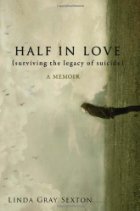
Review: Half in Love: Surviving the Legacy of Suicide by Linda Gray Sexton

I’ve literally been agonizing over this review for months now; it’s time to put it out there, even though I still don’t feel like I’ve quite gotten it “right”...

Opening lines of the book:

“Sometimes, even my bones resonate with the melodies of my childhood.

Ebullience and depression; love and warmth; the frightening separations and the joyous, if fragile, reunions. This is how I come to remember, simply because the old rhythms will always reverberate, always remain.”

Why I read it:

Years ago, when I was in my teens and early twenties, I was obsessed with the lives of Sylvia Plath and Anne Sexton, two of the earliest (and most famous) confessional poets. I read everything I could find about both of them, which in Anne Sexton’s case included her daughter Linda Gray Sexton’s first memoir Searching for Mercy Street: My Journey Back to My Mother, Anne Sexton and at least two of her novels. So I was thrilled to be offered a review copy of Linda’s second memoir, Half in Love: Surviving the Legacy of Suicide. (Some of you may also remember that I looked everywhere for this memoir at BEA least year.)

What it’s about:

As Linda says in the preface to Half in Love, her first memoir “focused on coming to terms with [her] mother’s life,” while in this book she comes to terms with her mother’s death—at the same time confronting her “own struggle with depression, bipolar illness, and [her] family’s history of successful suicides” (p. xii). As determined as Linda was not to subject her children to what she’d endured as a child—after repeated suicide attempts, Anne Sexton succeeded in taking her own life in 1974 when Linda was 21—when she reached the age her mother was when she died, Linda found herself sliding inexorably into a deep depression that led to her first suicide attempt in 1997. Half in Love is a frank and unflinching portrait of the next decade of Linda’s life as she deals with depression, nearly constant migraines, suicide attempts and cutting.

What worked:

One of the most important messages in this book is that the belief that love should be enough to overcome suicidal tendencies contributes to the passing on of a legacy of suicide: “This misperception traumatizes those who experience the loss of someone close (certain that if they had only been more worthy, their friend or family member would have loved them enough to bear the suffering), and it also becomes an obstacle for those who survive the attempt to end their own lives” (because they feel guilty and ashamed that they didn’t love their families enough not to try to commit suicide, which only adds to their suffering) (pp. 215-216). As Linda points out “it was not a question of pain versus love; in this equation the two different levels of sensation were never in competition because they were as different as a skateboard and a Mack truck” (p. 215). After reading Linda’s memoir, I almost feel like this should be obvious; yet the idea that suicidal people are selfish is widespread and deeply entrenched.

What didn’t work:

I’ve been having a hard time writing this review because much as I believe this memoir is important given how prevalent (and misunderstood) suicide is in North America,* I didn’t really like Linda’s writing style. The images she uses often fell flat or were jarring: suicide “came up from behind and took [her] in a bear hug” (p. 5); when she tries to kill herself for the first time, she “was ready to make music with the keyboard of [her] wrist” (p. 7); and when the police come to save her, they “came to [her] in a roll of thunder” (p. 9). And although she describes each cutting incident and suicide attempt in great detail, she doesn’t provide much insight into her healing process. Instead she writes vague things like: “My medications were in balance, my therapy was stellar, and my moods grew more and more stable” (p. 273).

Final thoughts:

As I was writing this review, I couldn’t help but think of a recent blog post by memoirist Dani Shapiro entitled “On Writing for the Right Reasons,” in which she quotes from an Ann Beattie short story about a writer: “He had tried to write for the wrong reason: to exorcise demons instead of trying to court them.” I wouldn’t go so far as to say that Linda is writing for the wrong reasons; however, I did get the impression that she is still exorcising her demons through her writing. This unfortunately left me feeling that I got too many details and not enough insight into her experience and recovery.

Thank you to Counterpoint Press for sending me this book for review.

*In the U.S., someone commits suicide every seventeen minutes, according to the statistics Linda provides at the end of her book.
_______________________________________________

Half in Love was on blog tour with TLC Book Tours in January and February. Visit these other blogs for reviews:

Savvy Verse & WitLife in ReviewRegular RuminationBook Club Classics!Necromancy Never PaysColloquiumRundpinneBoarding in My FortiesThe BookwormIn the Next RoomRed Headed Book ChildSuko’s Notebook

Other reviews: The Divining WandThe New York Times

Guest posts: ColloquiumShe Is Too Fond of BooksIn the Next Room

Author interview: Savvy Verse & Wit
_______________________________________________
Friday, May 13, 2011

Brogan’s Review: Cool Water by Dianne Warren

It’s been a while since I’ve posted one of my sister Brogan’s reviews. Here’s her latest, a review of Cool Water by Dianne Warren.

I was really drawn to Cool Water by Dianne Warren. It wasn’t the cover, it wasn’t the title, it wasn’t even the opening paragraph. What got me was Fred Stenson’s blurb on the back cover: “That two people can share a house and not know they love one another; that a note in a pocket with a woman’s name on it can crack decades of trust—this is a novel about the isolation that we hold secret within ourselves . . . It tiptoes the fine edge between joy and weeping.”

Cool Water is set in a small Western Canadian community, the fictional town of Juliet, Saskatchewan, where a cast of characters set the tone and rhythm of the novel’s unfolding with hardly a hand wave in the direction of plot. Through a series of coincidences, several characters are all insomniac on the same night, as the book opens. The story then traces the next day as the townsfolk live out personal dramas and interact with each other.

The central character is Lee Torgeson, who neatly circumscribes the story by spontaneously stepping out of his habits and obligations, taking off on a lost horse and riding into the night and through the next day, reflecting on life in Juliet and his recent loss of both his adoptive parents. While this wander seems unlikely, it also allows for lengthy musings and the view of an outsider on a place that is his own, but also isn’t.

I tend to read character-driven stories, so Cool Water is right up my alley. I also like multiple viewpoints, criss-crossing subplots, and a little bit of local taste and colour. Because I live in a small town, I understand how life can feel like a play sometimes, as well as a gossip-mill, and I like reading a fictional version done well, where characters’ interior lives are complex and idiosyncratic, and their interactions are sometimes deceivingly superficial and banal. All of these aspects are pluses for Warren’s novel.

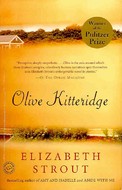
The book reminded me of two other books: Sounding Line by Anne DeGrace, and Olive Kitteridge by Elizabeth Strout. Sounding Line had the same small-town feel and fixtures: in Sounding Line, it’s a cafĂ© and the people who run it; in Cool Water, the hardware store and the woman who works at the post office. These are the places around which the towns orient themselves, with all their various characters; these are the reference points that touch everyone, the hubs of activity, the channels of information. Sounding Line is set in a fictional Nova Scotia town and was inspired by the events surrounding a UFO sighting in the real town of Shag Harbour in the sixties. Primarily, though, the book is a character exploration, centred on a boy losing his mother to cancer.

Olive Kitteridge by Elizabeth Strout is in this same style, although it’s a grouping of short stories and so doesn’t have the same effort towards a narrative line as the other two. Olive Kitteridge is set in a small town in Maine and follows both the life of Olive Kitteridge, a somewhat curmudgeonly now-retired schoolteacher, as well as the lives of a cast of characters who happen to live in the same town. The interconnected stories all mention Olive at least in passing, but are not necessarily about her in any significant way and don’t necessarily return to the same characters at any other point in the book, other than several about Olive and her husband Henry.

The challenge of such books is to create a world that feels authentic in its ordinariness, but has enough going on in it to make it interesting to read about. The first half to three-quarters of Cool Water succeeds in this venture admirably. The characters and their evolutions are delightfully understated, yet interesting—I think of the woman, mother of six kids, who swears she’ll put up the beans the next day, only to get up and find a pretext to go to town—and it’s so clear she’ll never get back in time to do the beans. I found myself relating to this character so much in this struggle that I truly don’t know if it was more funny or sad.

The problem with Cool Water is that at some point Warren decides to start making an ending for it, and as she ties up each character’s story, she loses something of the finesse of her craft, which was in listening to the characters and letting them drive the story forward. Instead, the changes they undergo towards the end seem sudden or unbelievable, or the denouement is just too self-conscious—which is jarring for a reader who was believing in the characters as people, to suddenly feel like they don’t “smell right”—that the author just needed to finish their stories.

In the end, I think Cool Water was more enjoyable in the reading of it than in thinking about it after the fact—it just doesn’t have that much to stay with you at the end of it, which is unfortunate for a book that initially had such perfectly executed emotional tensions.

Cool Water won the Governor General’s Literary Award for Fiction in 2010.
_______________________________________________

Other reviews:

A Bookworm’s WorldCaribousmomCurled Up with a Good Book and a Cup of TeaDaisy’s Book JournalKate’s BookcaseKevinfromCanadaLindy Reads and ReviewsThe Book ChickThe Gleeful ReaderThe Indextrious ReaderWise Monkeys

Guest posts by the author: A Bookworm’s WorldThe Book ChickThe Gleeful Reader

Interview with the author: Read, Play, Blog
_______________________________________________

Friday, February 11, 2011

Review: Lonely: Learning to Live with Solitude by Emily White

Lonely: Learning to Live with Solitude by Emily White chronicles White’s own battle with loneliness in her mid-thirties and provides an extensive overview of current research on loneliness, including interviews White conducted with lonely people who contacted her through her blog. Lonely is a portrait of loneliness written by someone who has experienced chronic loneliness, but it’s not a straight memoir, nor is it about “learning to live with solitude.”*

I initially found myself having a strong negative reaction to White’s personal story. In chapter 1 (called “Premonition”), White recounts how she reread the diaries she wrote at 19 in which she predicted “a life lived at a distance from everyone else” for herself (p. 17). She offers this as evidence of some sort of uncanny ability on the part of her younger self to see into the future, “as though . . . a sort of chronological porthole opened up, and I was able to catch glimpses of what my future would hold” (pp. 17-18). Her conclusion irritated me: surely it was obvious that this was a self-fulfilling prophecy! Her dismissal of yoga classes and meditation retreats as “time alone . . . commodified into something that can be bought” (p. 55) also raised my hackles. I confess I found myself feeling judgemental and impatient—and this despite the fact that I have some experience with chronic loneliness myself.

However, when White starts to investigate loneliness in an attempt to come to grips with what’s happening to her, my feelings about this book shifted and I started to feel more compassion for her story. White makes a convincing case for the fact that under the “right” circumstances anyone can become lonely, that the stereotype we have of the lonely as needy and desperate and unattractive (or worse, dangerous) is in fact not founded on reality, that loneliness is something quite different from depression and that it deserves to be studied and treated in its own right.

Although White spends a chapter defining and discussing the terms associated with loneliness, her focus is very much on loneliness as a result of isolation (which is what she experienced) and not so much on loneliness that results from not feeling connected even when you are with people (which is more the type of loneliness I’ve experienced). In addition, although she is an introvert, she barely mentions the possibility that introverts and extroverts might have different experiences of loneliness. As an introvert, my relationship to solitude/loneliness feels complicated: on the one hand, like everyone else, I need to connect with people, but on the other hand, I also need time alone—and certain types of social interactions generally don’t work for me. I would venture to guess that, at least some of the time, I feel lonely when I’m with people because I’m in a not-introvert-friendly situation. But White doesn’t seem to make that distinction: for example, her story of going on a bike trip in the hope of becoming “gregarious, embedded, fearless” (p. 159) sounds like a nightmare to an introvert—it’s no wonder the trip was a disaster. White, however, attributes the failure of this strategy solely to her loneliness, and not to introversion. More than once, it seemed to me that her discussion of loneliness could have been informed and enriched by looking at it through the lens of introversion/extroversion.

So much of the research White examines was interesting and thought-provoking and sometimes scary—I wished I had someone to discuss it with right away, especially as I wasn’t always sure I agreed with White’s conclusions. Despite the issues I had with Lonely, it makes for fascinating reading and is certainly an important book: if you have any interest at all in loneliness, I recommend reading it.

Thank you to Harper Perennial for sending me this book to review.

*The book’s original title was Lonely: A Memoir—unfortunately, neither of the subtitles is very accurate.
_______________________________________________
Lonely: Learning to Live with Solitude was on blog tour with TLC Book Tours in January and February. Visit these other blogs for reviews:

The House of the Seven TailsSophisticated DorkinessSilver & GraceBookNAroundConfessions of a BookaholicLisa’s YarnsIn the Next RoomSara’s Organized ChaosA Certain Bent Appeal

Other reviews:

BookPageBust Magazine (spoiler alert!) • S. Krishna’s Books

Guest post: In the Next Room
_______________________________________________

Thursday, December 23, 2010

Review: The Alchemist: A Graphic Novel by Paulo Coelho

The Alchemist: A Graphic Novel by Paulo Coelho is a graphic adaptation of the bestselling novel by the same name (adapted by Derek Ruiz with artwork by Daniel Sampere and others). It’s the story of Santiago, a young shepherd from Andalusia, Spain, who has a dream about a treasure buried near the pyramids of Egypt.

Several people recommended The Alchemist (in its original incarnation) to me, and I tried reading it but couldn’t get past the first few pages. When I saw that a graphic adaptation of the novel was going to be touring with TLC Book Tours, I jumped at the change to give this story another try. And I’m glad I did: the story is clever and engaging. I had just finished reading The Wisdom to Know the Difference by Eileen Flanagan (read my review), in which she talks about how we each have a purpose or calling, so this story about following your “personal legend,” as Coelho calls it, resonated with me—I read it all in one sitting (and then read it again).

However, there is also much about the book that bothered me. I suspect that some of the elements that I found confusing are probably explained more clearly in the original novel. For example, Narcissus’s story in the prologue didn’t make much sense to me (I didn’t see what it had to do with the rest of the story), nor did I see the purpose in including the page in which Santiago fantasizes about killing his sheep. I also found the section when Santiago is travelling with the Englishman to be very disjointed—the first time I read it, I thought the publisher must have made a mistake and left out several panels!

Some of my other issues had more to do with the graphic adaptation itself: I disliked the drawings of the female characters, who were either scantily clad buxom babes or (in one case) looked like a man in drag. In addition, near the end of the book, some of the text in the word bubbles is much smaller than the rest, which gave me the impression the character in question was whispering, which I don’t think was the case.

However, I also had problems with the story itself. I disliked some of the supernatural/magical elements of the tale—unfortunately, I can’t tell you more without giving some of the story away. But the biggest problem I had with the book was its sexism: Santiago needs to go out and follow his personal legend to its conclusion but Fatima finds her treasure in a man.

Overall, I’m glad I read the book, but given my reservations about it, I can’t wholeheartedly recommend it. And I can’t said that reading it has made me want to read the original novel!
_______________________________________________

The Alchemist: A Graphic Novel was on blog tour with TLC Book Tours in November and December. Visit these other blogs for reviews:

One Book Shy of a Full ShelfThe Zen LeafThere’s a BookThe Brain LairColloquiumWise Owl Book ReviewsSophisticated DorkinessJenn’s BookshelvesIn the Next RoomLove, Laughter, and a Touch of Insanitynomadreader

Other reviews: Broken FrontierThe Books in My Life

Read an excerpt from the book: Graphic Novel Reporter
_______________________________________________

Friday, October 22, 2010

Review: Up from the Blue by Susan Henderson

Up from the Blue by Susan Henderson is the story of Tillie Harris told from two turning points in her life: as an adult when she is about to give birth to her first child and as an eight-year-old child the year when everything changed for her family.

I loved the first half of this book. Tillie is an insightful and imaginative child coping with a difficult home life as best she can, desperately holding on (or inventing) any good moments her family has:
“The parade music jiggled my insides, and lifted the hair up on my arms. I wanted to be the girl with the pom poms tied to her shoes, jabbing a baton at the sky. I danced along behind my father, danced to the womp-womping of the tuba, the wild drumming. I trotted with fancy steps, keeping my eyes on my father’s hand, held out to the side with his fingers spread apart. If I could only catch up, I knew he’d take hold.” (pp. 20-21)
I was completely drawn into this story: it was one of those books that I itched to pick up again as soon as I put it down. Although I didn’t totally identify with Tillie (I was definitely a “good girl” as a child, while Tillie is constantly getting into trouble, both at home and at school), I could certainly identify with her loneliness and sense of alienation.

Unfortunately, midway through the book, my disbelief came crashing down around me: what happened to Tillie’s mother didn’t seem plausible to me, and as Tillie unravelled the events of that year, she no longer seemed believable as an eight-year-old narrator. One could argue that Tillie was only metaphorically eight years old—that at some level the adult Tillie was trapped in that traumatic year when everything changed—which would explain her mature thinking about what happened to her and her mother. Although this does make sense, I still can’t quite buy some of the plot twists. However, despite my disappointment at where the story goes, Henderson has crafted an absorbing debut novel, and I look forward to reading whatever she writes next.

Thank you to Harper Collins for providing me with this book to review.
_______________________________________________

Up from the Blue was on blog tour with TLC Book Tours in September and October. Visit these other blogs for reviews:

The Zen Leaf
Sara’s Organized ChaosMusings of a Bookish KittyReviews from the HeartRundpinneBooks Like BreathingIn the Next RoomRaging BibliomaniaLife in ReviewPeeking Between the Pageslit*chickBooksie’s Blog

Other reviews:

A Musing ReviewsBibliophilic Book BlogBooking MamaDan’s JournalFizzy ThoughtsHey, I want to read thatKellyVisionlargehearted boyLiterary Kicksmy books. my life.The Best Damn Creative Writing BlogThe Book Pirate

Excerpt from the first chapter of the book: The House with the Blue Door

Two of my favourite quotes: Teaser Tuesday (on my blog)
_______________________________________________

Tuesday, June 22, 2010

Reviews: The Best Defense by Kate Wilhelm and Careless in Red by Elizabeth George

The Best Defense by Kate WilhelmThe Best Defense by Kate Wilhelm is the second of her Barbara Holloway mysteries and in a word it is brilliant. Holloway is an attorney in Eugene, Oregon, who with some reluctance takes on the case of “Baby Killer” Kinnerman, a woman accused of murdering her young daughter. The case looks hopeless—Barbara’s client has already been tried and convicted by the press. Although grieving herself, Barbara rises to the occasion, and watching her slowly build her case makes for gripping reading. This was a reread for me, but I didn’t remember what happened at all and enjoyed The Best Defense just as much the second time around. Barbara is a great character: she is a strong and intelligent woman who is passionate about justice. This is Wilhelm at her best. If you enjoy courtroom dramas, you won’t want to miss this one.

Careless in Red by Elizabeth GeorgeIt’s hard to review Careless in Red by Elizabeth George without spoiling any of the previous books in her Lynley/Havers series (this is book 15), but I will do my best (which means I won’t tell you much about the plot).

Devastated by personal tragedy, Detective Superintendent Thomas Lynley has been walking along the Cornish coastline for 43 days when he comes across the body of a young man who has fallen to his death. As the local police are short-staffed, Lynley reluctantly becomes involved in the investigation.

George’s strength is her ability to get into her characters’ heads, telling the story from multiple points of view yet still keeping her readers in the dark as to who did it and why. However, I often feel like her endings are a bit anti-climatic, perhaps because she focuses on so many characters and then inevitably drops them at the end to unravel the mystery. Careless in Red is no exception on both counts—although for the first time I found the characters a bit hard to keep track of at the beginning (which I attributed in part to their odd names). Because I was so deeply disappointed with With No One as Witness (book 13)—and skipped the next book, What Came Before He Shot Her—I was glad this book returned to more familiar ground. If you’re still reading this series, I definitely think this one is worth it—it satisfied my George craving and hopefully the next one will be even better. However, if you haven’t read any of her books yet or are reading them out of order, I’d recommend reading books 1-12 before any of the more recent ones.
_______________________________________________

Other review of The Best Defense (contains spoiler of first book): Jandy’s Reading Room

Other reviews of Careless in Red (all contain spoilers of earlier books):

A Work in ProgressEurocrimeMysteries in ParadisePetronaReactions to Reading
_______________________________________________

Tuesday, May 4, 2010

Review: The Happiness Project by Gretchen Rubin

One day, while sitting on a bus, Gretchen Rubin had an epiphany of sorts: she was, as she put it, “in danger of wasting [her] life.” This moment made her realize two things: she wasn’t as happy as she could be and her life wasn’t going to change unless she did something about it. Thus was born the idea behind The Happiness Project: Or, Why I Spent a Year Trying to Sing in the Morning, Clean My Closets, Fight Right, Read Aristotle, and Generally Have More Fun. Inspired by Benjamin Franklin, Rubin designed a Resolutions Chart and decided to tackle a different subject every month for a year. She also came up with a list of Twelve Commandments and a goofier list of what she calls the Secrets of Adulthood.

I’ve struggled with reviewing this book for quite a while now because, quite simply, it wasn’t what I expected. I thought it was going to be more of a memoir and less of a self-help book. And I’m having trouble deciding whether my disappointment with the book stems mainly from the fact that it didn’t meet my expectations or whether Rubin’s approach weakened the impact of the book regardless of my expectations. (But maybe that distinction is moot, and I should just quit waffling and tell you what I thought...)

One of Rubin’s Commandments and one of her Secrets of Adulthood really hit home for me (and they are complementary concepts). Her first commandment is “Be Gretchen” (or be yourself), which is self-evident perhaps and yet sometimes so easy to forget. (An aside to give you an idea of where I’m coming from: When I was in high school, my mother’s best friend gave me a poster for my birthday that said: “I may not be perfectly wise, perfectly witty or perfectly wonderful, but I’m always perfectly me.” I dutifully tacked the poster to my wall but felt taunted daily by its message. As a “brainy” and socially awkward teen—and still sometimes to this day—I often felt like I didn’t know who “me” was, and I certainly didn’t feel I had the level of acceptance I needed to be “perfectly me.”) The variation on this theme that’s one of Rubin’s Secrets of Adulthood is “What’s fun for other people may not be fun for you—and vice versa.” Again, this seems obvious and yet as an introvert, I often forget this piece of wisdom and think there’s something wrong with me when I dread the party that supposed to be so much fun or would rather spend hours in a second-hand bookstore instead of hanging out in the pub.

Much of Rubin’s research on happiness is fascinating and her advice is pretty spot-on; this book did get me thinking about ways I can work towards my own happiness (and was in part the inspiration behind my 40/40 Challenge). However, I felt frustrated with how self-conscious The Happiness Project is: it always felt like Rubin was too aware of her readers; her stories seemed too pat, too constructed somehow. I wanted her to dig deeper and get messier, to share more. I was annoyed that she quoted so extensively from people’s comments on her blog (some of the quotes are pages long) instead of including more details about her struggles to follow through with her happiness project. I guess in the end I didn’t identify with her enough: it seemed like the distance she had to travel from status quo to happy (or happier) was too short—and too easy—for her approach to apply to my own life.

Thank you to Harper Collins for sending me this book to review.
_______________________________________________

Other reviews:

5 Minutes for MomA Patchwork of BooksA Reader’s RespiteAriel GoreA Striped Armchair (scroll down for review) • Bibliophile by the SeaBooks on the BrainChew & Digest BooksErin ReadsHope Is the WordLesa’s Book CritiquesLiving ArtfullyPop Culture JunkieRulyS. Krishna’s BooksSophisticated DorkinessThe Book Chickunclutterer
_______________________________________________

Friday, March 26, 2010

Review: Conscience Point by Erica Abeel

Conscience Point by Erica Abeel is the story of Maddy Shaye, a woman “with all the luck,” who seems to have it all: she has a successful career as both a concert pianist and an arts reporter, is in love with adoring Nick and has a close relationship with her grown daughter Laila. But then everything starts to unravel...

Eight pages into Conscience Point, I nearly gave up on it: Abeel’s overuse of ellipsis points was driving me crazy (they appear about 20 times in those eight pages), plus the sex scene made me cringe.* Luckily, I chastised myself for my lack of perseverance–surely the book deserved at least a 50-page chance!—and picked it up again. Ironically enough, after page 8, the ellipses all but disappear and the story quickly picks up the pace.

Although the book is mostly written in the third person, it begins with—and occasionally lapses into—a first-person segment that make it clear that Maddie is actually writing her own story, a “faux memoir,” as she calls it. This device worked well: although I sometimes found the writing style frustratingly cryptic (or at least there were many references that sailed over my head), Maddie’s character is so well developed and so believable that it was Maddie I was frustrated with and not Abeel.

My favourite part of the story was the Gothic mystery—in the end I tore through the book to find out what had happened—and this despite the fact that I found the idea of the love triangle fairly distasteful. Although this book was not an easy read—it was definitely outside my comfort zone—I’m glad I gave it a second chance.

To read other reviews of this book, visit these blogs:
Booking MamaBookstackDiary of an EccentricLinus’s BlanketLiterary LicenseSavvy Verse & WitS. Krishna’s Books

To read an interview with the author, visit this site:
Novel Journey

Thank you to the author for sending me this book to review.

This book review is part of the Spotlight Series tour for Unbridled Books. Visit the Spotlight Series site for a list of other tour stops.

*I later reread it and it didn’t seem that bad.

Friday, January 29, 2010

Review: i am neurotic (and so are you) by Lianna Kong

i am neurotic (and so are you) is not so much by Lianna Kong as it is edited by her: in 2008, she created the website i am neurotic and invited people to submit their neuroses. This book is thus a collection of anonymous confessions by self-described neurotic folk with photo illustrations by Matthew Stacy. Oddly enough, the book had the opposite effect from what I’d imagined: I felt decidedly un-neurotic after reading it.

On second thought, though, I can think of a few of my neuroses (past and present):

  • I hate having anyone listen to me while I talk on the phone, including my partner, Mr. B. This means I will go into another room and close the door when ordering takeout for both of us.
  • I hate straight apostrophes and quotes, and I go out of my way to replace them with curved ones. (I copy and paste the curved ones into all my blog posts.)
  • I’m paranoid about getting lost even when I’m going somewhere I’ve been several times before. This is especially true if the journey involved taking a bus. I have this irrational fear that I’ve gotten on the wrong bus (even when I know I haven’t) or that the landmarks will have changed or somehow moved since I was last there.
  • I used to make a point of never walking on city grates—I was afraid I’d fall through one. Then one day I read a magazine article that recommended letting go of an irrational fear (or something along those lines). Since then, I walk on them if they happen to be on my way.

OK, so maybe I am a bit neurotic after all!

i am neurotic (and so are you) is an entertaining (and sometimes somewhat disturbing) read. While this is not the type of book I would buy for myself (it has limited re-readability value), it could make a great gift.

To read other reviews of this book, visit these blogs:
A Bookworm’s WorldBetter with BooksCindy’s Love of BooksPop Culture JunkieReading to MyselfStarting FreshThe Routine Ramblings of a Disorganized Perfectionist

Thank you to Cindy at Cindy’s Love of Books for giving me this book to read.

What about you? Are you a bit neurotic too?

Thursday, July 30, 2009

Places I Never Meant to Be: Original Stories by Censored Writers edited by Judy Blume (a review)

Places I Never Meant to Be edited by Judy BlumeAs I’ve mentioned before, I’m not a big fan of short stories; however, they can make great “palate cleansers” between courses of full-length books and I enjoy anthologies as they are a good way to discover new writers. This particular anthology, Places I Never Meant to Be: Original Stories by Censored Writers edited and with an introduction by Judy Blume, also supports a good cause: sales of the book benefit the National Coalition Against Censorship and the collection was obviously put together to raise awareness of this issue. Judy Blume’s introductory essay was a bit of an eye-opener for me: in it she details her battle with the censors (which was going on when I first read her in my teens in the 80s), including the fact that she caved in to editorial pressure and changed a passage in her novel Tiger Eyes. She also pays tribute to a few of the folks in the trenches, including several teachers who fought against the censors at great personal cost.

As might be expected, all 12 contributors to this book are YA authors, only 3 of which were already familiar to me (Norma Klein, Norma Fox Mazer and Paul Zindel). Three of the stories stood out, although I did enjoy the other nine (they just weren’t as memorable). My favourite was “The Beast Is in the Labyrinth” by Walter Dean Myers, a moving story about a brother and sister from Harlem who escape where they come from in very different ways. The other two were notable only because I disliked them so much: “Love and Centipedes” by Paul Zindel and “Lie, No Lie” by Chris Lynch. Zindel has never appealed to me: I didn’t like his writing when I first encountered it as a teen and 20+ years later I still don’t. This offering is a grim story of cruelty to animals and revenge that lacks subtlety or humour. Lynch’s story about two very different boys starts off promisingly enough (I love this quote: “He provides me with the whoosh that makes the drag-ass parts of living more worth it; and I provide him with the vacuum of experience that allows him to still feel any whoosh at all”) but soon devolves into a disturbing tale of manipulation and nonconsensual gay sex. (And it somehow feels wrong to dislike these two stories so much when they’ve been published in an anthology against censorship—as if by doing so I’m colluding with the censors, even though that’s obviously not my intention!)

Despite my reservations, overall this book is a good read made all the more interesting because each story is followed by a brief one- or two-page commentary on censorship by the author.

For other reviews, visit these sites:
Children’s BookPageOpen Mind, Insert BookReading Rants!Teenreads.com

You can also read Judy Blume’s introduction to this book on her website.

Finally, head over to this site for an interview with Blume:
Children’s Literature

Thank you to Aerin at In Search for Giants for sending me this book.

Friday, June 12, 2009

Sister Wife by Shelley Hrdlitschka (a review)

Sister Wife by Shelley HrdlitschkaSister Wife by Shelley Hrdlitschka is told from the alternating points of view of three teenagers living in the polygamous community of Unity: rebellious Celeste, a 14-year-old girl who is about to be “assigned” to an older man and become a sister wife; virtuous Nanette, Celeste’s younger sister; and Taviana, a young woman who was rescued off the streets by one of the men in the community. This is an interesting device because it allows Hrdlitschka to explore what it would be like to live in Unity from three very different points of view. For the most part, I enjoyed the book: I sympathized with Celeste’s plight and was curious to find out what would happen to her. I particularly loved how Hrdlitschka used the inuksuks to introduce Celeste to another way of looking at the world. Unfortunately, I also felt that Hrdlitschka tried too hard to be non-judgemental, which made the book both less interesting and less realistic. The last chapter in particular seemed to be suggesting that polygamy is just another lifestyle choice that works for some and not for others, which is a dangerous message in my opinion.* In addition, the denouement of Celeste’s story didn’t strike me as particularly realistic. Having said that, I’m still going to recommend Sister Wife, with reservations, to readers who are interested in polygamy, if only because I want to know what you think of the ending!

For other reviews, visit these blogs:
Abby (the) LibrarianA Patchwork of BooksBecky’s Book ReviewsBook AddictionBookshelves of DoomMaw BooksS. Krishna’s BooksTeen Book ReviewThe Book Zombie

Thank you to Cindy at Cindy’s Love of Books for giving me this book to read.


This is the sixth book I review for the New Authors Challenge.


*I’m not suggesting that polygamy is inherently wrong, only that being married off to an older man at the age of 15 is not a lifestyle choice. It actually isn’t a choice at all.

Friday, April 3, 2009

Acedia & Me: A Marriage, Monks, and a Writer’s Life by Kathleen Norris (a review)

Acedia & Me: A Marriage, Monks, and a Writer's Life by Kathleen NorrisI have been struggling with my review of Acedia & Me: A Marriage, Monks, and a Writer’s Life by Kathleen Norris for quite a long time now, not only because I find nonfiction more difficult to review in general, but also because Norris’ struggle with acedia resonated with me on a personal level and I’m having trouble articulating my thoughts about this book without rambling.

At the beginning of the book, Norris explains that:
“At its Greek root, the word acedia means the absence of care. The person afflicted by acedia refuses to care or is incapable of doing so. When life becomes too challenging and engagement with others too demanding, acedia offers a kind of spiritual morphine: you know the pain is there, yet can’t rouse yourself to give a damn. . . . Caring is not passive, but an assertion that no matter how strained and messy our relationships can be, it is worth something to be present, with others, doing our small part. Care is also required for the daily routines that acedia would have us suppress or deny as meaningless repetition or too much bother” (pp. 3-4).
Norris’s definition of acedia reminded me of looking through photo albums with my partner’s father—there were his young parents surrounded by their children, and as we flipped through the pages, they aged and eventually slipped away altogether as their children became parents in turn. Having watched nearly whole lives flash before my eyes, a feeling of hopelessness washed over me as my partner’s father morphed from handsome youth to old man literally before my eyes. This is the whisper of acedia, murmuring that there is no point in living because inevitably we all just age and die.

Norris gives an example of how acedia can take hold of her life:
“It begins as a deceptively slight shift in thought, or rather—in a process much commented on by the desert monks—a quick succession of thoughts that distract me from my right mind. I’ve been working too long and need a break; maybe I should read a mystery novel to clear my head. I tell myself that I’m too weary to concentrate. I tell myself that it is a matter of respecting my limitations, and of being good to myself [my emphasis]. If I manage to read one book, and then return to my other obligations, no harm is done. But often, one book does not satisfy me. My ‘rest’ has only made me more restless, and as I finish one book, I am tempted to pick up another. If I don’t check myself, I can slip into a state both anxious and lethargic, in which I trudge through four or five paperbacks a day, for three or four days running. I am consuming books rather than reading them. . . . The contemporary maxim, ‘Listen to your body,’ is useless to me when all I want to do is lie down, turn pages, and ignore that ringing phone [my emphasis]” (pp. 15-16).
This resonated deeply with me: reading this passage was an “aha” moment. I do this. I know this helplessness in the face of what seems like mindless repetition, this hollowed-out feeling like nothing matters, everything is meaningless. I’ve also struggled with the fact that in those moments listening to my body doesn’t feel helpful at all.

Norris goes on to meditate on the nature of acedia based primarily on the writings of early monks, as well as to examine its impact on her life, her writing and her marriage. Although I would recommend Acedia & Me to anyone who identifies with Norris’s description of acedia—this book certainly gave me a different perspective on my own “soul weariness”—I found the book lacked narrative structure. It is possible to combine a more scholarly approach with a memoir: Noelle Oxenhandler did it successfully in The Wishing Year: An Experiment in Desire, which I just finished reading recently. Unfortunately, Acedia & Me felt disorganized to me, as if Norris did not have enough distance from the subject matter to write about it clearly. I also wished the book was more personal—with more about her marriage and her writing life and less about the desert monks (these parts of the book started to feel repetitive after a while). Despite this, Acedia & Me is a thought-provoking primer on the all-but-forgotten sin of acedia. Norris even includes a commonplace book at the end of Acedia & Me, with quotes about acedia throughout history, starting with the Psalms and Seneca and ending with contemporary writers as diverse as Anita Brookner, Maurice Sendak and Roland Barthes.

For other reviews, head to these blogs:
Liz Is NostalgicMuse Books ReviewsQuotidian GraceRaging Bibliomania

To read an interview with Kathleen Norris at The Other Journal:
Naming an Ancient Affliction in a Postmodern Age, Part I
Naming an Ancient Affliction in a Postmodern Age, Part II

Thank you to Riverhead Books for sending me this book to review.

Monday, February 23, 2009

The Only True Genius in the Family by Jennie Nash (a review)

The Only True Genius in the Family by Jennie NashThe Only True Genius in the Family by Jennie Nash is the story of Claire, the daughter of a legendary landscape photographer and the mother of a talented young painter, who feels sandwiched between two “geniuses” despite a successful career as a commercial photographer. Dismissed as untalented at a young age by her father, Claire finds herself re-examining her life and what she thought she knew about his creative process after his death.

Claire’s whole life has been shaped by her father’s assessment (and abandonment) of her, and his death forces her to confront her ambivalence about the path she has chosen. Nash does an excellent job of portraying Claire’s loss of vision as an artist as well as her tempestuous relationship with her talented daughter. Although some of their interactions made me cringe, it was only because they seemed so painfully real. Nash asks big questions in this novel, to which there are no easy answers: Where does talent/creativity come from? What does it take to achieve success as an artist? What is the price of genius?

Unfortunately, the ending of the book was a bit of a let-down. I felt that Nash shortchanged Claire by rushing the ending, relying on somewhat clichéd images to provide a tidy end without fully exploring what I thought were some of the most interesting elements of the story: what Claire was going to do about what she had discovered about her father and how she was going to establish a healthier relationship with her daughter. Despite this, The Only True Genius in the Family is a worthwhile and thought-provoking read.

For other reviews, visit these blogs:
A Reader’s RespiteAt Home with BooksBooking MamaMaw BooksPeeking Between the PagesS. Krishna’s BooksThe Compulsive Reader

For author interviews, pop over to these sites:
At Home with BooksMaw BooksMother Daughter Book ClubThe Compulsive ReaderThe Urban Muse

Thank you to Jennie and Berkley Books for sending me this book to review.


This is the third book I review for the New Authors Challenge.

Monday, January 5, 2009

A Wood Engraver’s Alphabet by G. Brender Ă  Brandis (a review)

A Wood Engraver's Alphabet by Gerard Brender Ă  BrandisI’m embarrassed to admit that I misunderstood the blurb about this book on the Mini Book Expo site, so I was very surprised to realize A Wood Engraver’s Alphabet by Gerard Brender Ă  Brandis contains no words past the three-page introduction, other than the names of the 26 plants illustrated.

Although I am, in some small way, a “student of the complexities of nature’s creations,”* as I have studied herbology, my main interest is in wild medicinal plants, so I wasn’t familiar with many of the plants illustrated here. And I don’t really know anything about wood engraving. Disclaimers aside, this is a beautiful book: I love the texture of the book’s cover (which I can’t help stroking every time I pick it up), and the woodcuts themselves are intricate and lovely. A few of them seem too small to do justice to the details of the engravings, but for the most part I felt like I could spend hours gazing at each of them, marvelling at Brender Ă  Brandis’s skill and meditating on each plant. My favourites are the pussy willow (which is actually on the dedication page), a small and delicate woodcut that so clearly bursts with life, and the Bird of Paradise, which has captured the paradoxical elegance and gawkiness of this amazing plant (and which also happens to be the largest illustration in the book). One small quibble: being a bit of a purist, I was disappointed that “FoXglove” was used to illustrate the letter X. (Are there no plants with names that start with X?)

For other reviews of this book, visit these sites:
Associated Content (Josh’s review)Owl’s Court

Thank you to Mini Book Expo and The Porcupine’s Quill for sending me this book to review.


*According to the blurb on the back of this book, “This collection is intended both for the student of the complexities of nature’s creations and the patron of the intricate art of wood engraving.”

Tuesday, July 15, 2008

The Girl with No Shadow by Joanne Harris (a review)

The Girl with No Shadow by Joanne HarrisChocolat is one of my all-time favourite books, so I was delighted to receive a copy of its sequel to review as part of LibraryThing’s Early Reviewers program.

The Girl with No Shadow focuses less on Vianne’s story—instead it is told in the alternating voices of Vianne, her daughter Anouk and the mysterious Zozie. Joanne Harris writes each character with a distinctive voice (which was a good thing since the images identifying each section were not always the correct ones in my Early Reviewers’ copy).

While Chocolat could (almost) have taken place in the Middle Ages, this book has a much more modern feel, which contrasts more sharply with the book’s magical elements. It is also darker in tone but as engaging and as full of memorable quirky secondary characters as Chocolat was. Harris writes with her usual flair; however, I felt it took Vianne too long to clue into what was really going on and the ending stretched the limits of my credulity.

Harris has also neatly sidestepped the issue of the different endings in the book and movie versions of Chocolat, so this book works as a sequel to either. And although I generally don’t like it when publishers change the title of a novel to suit a different market, this time I think the American title better captures the darker edge of this book. (The original title was The Lollipop Shoes.)

(First posted on LibraryThing on April 7, 2008)