Showing posts with label TLC Book Tours. Show all posts

Wednesday, April 25, 2012

Review: This Life Is in Your Hands: One Dream, Sixty Acres, and a Family’s Heartbreak by Melissa Coleman

Opening lines of the book:

“We must have asked our neighbor Helen to read our hands that day. Her own hands were the color of onion skins, darkened with liver spots, and ever in motion.”

Why I read it:

I’m interested in memoirs about women who grew up outside the mainstream.

What it’s about:

In the late 1960s, inspired by Helen and Scott Nearing’s book, Living the Good Life, Melissa Coleman’s parents bought land on the coast of Maine from the Nearings, built their own home and cleared the land so they could farm it. This Life Is in Your Hands: One Dream, Sixty Acres, and a Family’s Heartbreak is a memoir about the 10 years Melissa and her family spent on the farm and how a tragic accident ended their dream.

My thoughts:

I have such mixed feelings about this book that it’s hard for me to sort them neatly into “what I liked” and “what I didn’t like” (or even express them very coherently). On the one hand, This Life Is in Your Hands is, for the most part, a beautifully written and heart-wrenching story of a family trying to live their dream and the terrible toll it took on them. On the other hand, there were several elements of the book that didn’t really work for me.

For starters, since the tragedy at the heart of this memoir happened when the author was quite young, I expected the book to focus on the aftermath of this event, rather than mostly lead up to it, as was the case. This was not a problem in and of itself; however, it did mean that much of this “memoir” was actually based on other people’s memories, as Coleman was too young to recall many of the details of her early life. (The story in fact begins before she’s born.) And perhaps because of that, I found the beginning of the book quite confusing: Coleman flits back and forth in time to set the scene for her tale, from her parents’ decision to move back to the land, to her very early years, to her parents’ childhoods and back again (with a few other back-and-forths for good measure). However, once she has established the background for her story, she tells the rest of it in mostly chronological order and I found myself engrossed in her book.

Little did I know when I picked up this memoir that Coleman’s father, Eliot Coleman, is one of the pioneers of the modern organic movement. As someone who is a big proponent of organic food, I was fascinated by this glimpse into the movement’s beginnings. Some of Eliot Coleman’s ideas were totally new to me, such as that “The role of insects with plants is like the role of wolves with deer and caribou: to eliminate the unhealthy and unfit” (p. 66)—in other words, if your plants are healthy, they will not attract pests.

Occasionally, the foreshadowing in the book fell flat: it felt like Coleman was hinting at stories that she then never really told. For example, she says “The Nearings would prove, like most mentors, to have clay feet, and their ideas fallible, but their achievements will always be an extraordinary example of the power of determination and effort” (p. 57). I expected her to say more about this, but the Nearings are actually fairly peripheral to this story. She also hints several times that her parents’ health issues were exacerbated by their vegetarian diet, but never elaborates, which, as a vegetarian, drove me crazy!

However, the book is also filled with beautiful passages that testify to the joys as well as the sorrows of the way of life Coleman’s parents embraced. For example:
Heidi and I were always outside, naked and barefoot, dancing on the blanket of apple blossoms, skipping along wooded paths, catching frogs at the pond, eating strawberries and peas from the vine, and running from the black twist of garter snakes in the grass. We lay in the shade under the ash tree, gazing up at the crown of leaves and listening to the sounds of the farm—birds calling, goats bleating, chattering of customers at the farm stand, and whispers of tree talk.

When you focused on the leaves fluttering in the dappled light, they vibrated and shimmered into one, becoming a million tiny particles. You felt a shift inside, and you began to vibrate too, on the same frequency as everything else. All secrets were there, all truths, all knowledge. You had to scan with your heart to find what you were seeking. It might no be spoken in words, it might be hidden in rhyme, in song, in images. You knew the tree and the earth were the same as you, made of particles, like you, come together in a different form. You loved it all as you loved yourself (p. 4).
And here’s another of my favourite passages:
However, one morning, as I lay in my bunk, the good feeling returned. It hadn’t come in a while and I was afraid I would scare it away because you can’t feel the good feeling and be aware of it at the same time. I was thinking about the way light creates the shapes of things, when suddenly I felt it, like a smooth stone in my mouth. My body dissolved its boundaries and became part of all things. Just as suddenly the feeling was gone, and I was me again, lying in my bunk as the ache of reality returned. [. . .]
The floorboards creaked as Mama drifted into the kitchen. From above in the bunk she looked soft in the light, her face still open from sleep, not closed up like during the day.
“Mama.”
“Ummmm?”
“Do you ever get the good feeling when you first wake up in the morning?”
“The good feeling?”
“Yeah, like a smooth stone in your mouth?”
“I’m not sure I know what you mean.”
“Like warm light surrounding your body.”
“That sounds nice.”
“Do you get that?”
“Not recently.” (pp. 292-293). 
Although I didn’t love this book, I’m glad I read it. If you want to learn more about the birth of the modern organic movement from the perspective of one family who became icons of this way of life, This Life Is in Your Hands is certainly a worthwhile read. I would also recommend it, with reservations, to anyone interested in farming memoirs.

Thank you to Harper Perennial for sending me this book to review.
_______________________________________________

This Life Is in Your Hands is on blog tour with TLC Book Tours this month. Visit these blogs for other reviews:

_______________________________________________

Tuesday, March 6, 2012

Review: Birds of a Feather by Jacqueline Winspear

Opening lines of the book:

“Maisie Dobbs shuffled the papers on her desk into a neat pile and placed them in a plain manila folder.”

Why I read it:

I read Maisie Dobbs, the first book in this series, a couple of years ago and loved it, so I jumped at the chance to read the second book during the March Is Maisie Month read-along.

What it’s about:

The year is 1930 and Maisie Dobbs, who calls herself a “psychologist and investigator,” has just been hired by a self-made businessman to find his runaway 32-year-old daughter. When three of the daughter’s friends are found dead, Maisie must dig deep to find out what happened to these women. Is the missing daughter the killer or the next victim?

What worked:

Jacqueline Winspear gets two things very right in this series. The first is Maisie herself. I love Maisie. I love her intelligence, her reliance on her intuition and gut feelings, her belief that coincidence is “a messenger of truth,” the fact that she meditates and that she can tell how a person is feeling just by imitating their posture. The daughter of a costermonger, Maisie was sent into service at age 13; however, she has also been educated at Cambridge and served as a nurse in World War I. As a result, she is now neither “upstairs” nor “downstairs,” which gives her a unique perspective on the world.

The second thing that Winspear gets right is the historical setting. I didn’t know much about this period before I read these books, but Winspear does an excellent job of portraying the cost of the Great War on civilians, nurses and soldiers alike. She also manages to make all her characters fully human—I felt for all of them, including the “bad guys” and unsympathetic characters. Having read these two books, I feel like I have a much better idea of what it would have been like to be living in England between the two world wars.

What didn’t work:

Because I reread the first book in the series just before reading this one, I found myself a bit dismayed that the end of Maisie Dobbs, which is so poignant, is recapped so bluntly at the beginning of Birds of a Feather. Mind you, I’m not sure I would have noticed this if I hadn’t literally just finished rereading the first book before starting the second.

[MINOR SPOILER]
I also found myself somewhat annoyed with the possible-love-interests plot points in this book: while it’s pretty obvious what the men in question see in Maisie, it’s not so clear what she sees in them. I found her interactions with them to be totally lacking in chemistry. I can’t help but hope that romance doesn’t become the focus of any of the subsequent Maisie books!
[END OF MINOR SPOILER]

Favourite quote:

“While she walked, Maisie remembered feeling a prickling of the skin on her neck while she stood in the upstairs hallway of [—]’s house, outside the room where her body lay. She had not shied away from the sensation but had instead silently asked, What is it you want me to see? Never before at the scene of a crime had Maisie felt such a duality of sensation, like a fabric that on one side is smooth and satin-like but on the other, rough with a raised pile. She knew that the last person who had come to the house came with a terrible burden, a burden that was no lighter for having taken [—]’s life” (p. 61).

Final thoughts:

Since I read the first two books back to back, I can’t help but compare them and I do think I liked Maisie Dobbs more (especially on second reading). However, Birds of a Feather is more of a classic mystery than the first one, and it kept me guessing until the end (although I did figure out the significance of one element of the story before the final reveal). If you are interested in World War I and the Interwar Period or just want to read a mystery series featuring a strong and quirky female sleuth, I highly recommend the Maisie Dobbs series. I generally never read books in series back to back, but I’m very tempted to dive into Pardonable Lies right away—I can’t wait to find out what happens to Maisie next!
_______________________________________________

To celebrate the hardcover publication of Elegy for Eddie (book 9, out on March 27, 2012) and the paperback publication of A Lesson in Secrets (book 8, out today), Harper Books is sponsoring the first annual March Is Maisie Month, which includes a TLC book tour of all the books in the Maisie Dobbs series thus far.

Visit these blogs for other reviews of Birds of a Feather:

The Adventures of an Intrepid ReaderA Few More PagesWordsmithsonia [spoiler alert!]

For a complete list of bloggers participating in the March Is Maisie Month read-along, visit the TLC Book Tours site.

Other reviews:

_______________________________________________

Friday, July 22, 2011

Review: Fire Monks: Zen Mind Meets Wildfire at the Gates of Tassajara by Colleen Morton Busch

Opening lines of the book:

“On June 21, 2008, lightning strikes from one end of drought-dry California to the other ignited more than two thousand wildfires in what become known as the ‘lightening siege.’”

Why I read it:

I’ve long been interested in Zen Buddhism and I was curious to read this story about Zen in action.

What it’s about:

In June 2008, after lightening started over two thousand wildfires across the state of California, Tassajara, the oldest Buddhist monastery in the United States, found itself right in the fire’s path—at the end of a single unpaved road deep in the wilderness. Fire Monks: Zen Mind Meets Wildfire at the Gates of Tassajara by Colleen Morton Busch is the story of the five monks who stayed to save the monastery after everyone else was evacuated (including the firefighters).

What worked:

Fire Monks is an extraordinary, multifaceted story and Busch does a good job of weaving together all the strands of her narrative: the story of the fire itself, the personal stories of the players involved, some of the history of Zen Buddhism in the U.S. and of Tassajara in particular, and the politics of firefighting in California at the time. While on one level the book reads like an adventure story, its main appeal (to me at least) is as a study of Zen Buddhism in action. Though most of us are unlikely to be in a position to meet fire as these monks did, as Busch points out, “fire [is] the perfect metaphor for anything that comes uninvited and threatens to hurt us or the people and places we love” (p. 2). I found the story both moving and enlightening.

What didn’t work:

The large cast of characters was confusing at times, but a list of the main ones is included at the beginning of the book, which helped enormously. The one thing that I didn’t always follow was the politics between the different levels of firefighters involved. Although it was necessary to include some of this in the book to provide context for why certain decisions were made—this was the third wildfire that Tassajara faced, but the only one where the monks were left to their own devices—I was also least interested in this aspect of the story.

Favourite quote:

“The Greek philosopher Heraclitus said that you cannot step in the same river twice. A Zen master might add cheerfully: You cannot step in the same river because there is no river, there is no actual you. The river and you and your steeping are in a dynamic and interrelated state of constant change. Maybe it is the river that steps into you. Maybe there is only stepping, no one to step or thing to step into.

“In Zen, you can’t really make a ‘wrong’ decision. But you can’t make a ‘right’ decision, either. You can only respond moment to moment in a way that feels the least harmful and deluded, the most compassionate and true.

. . .

“As a ring of flame looped around Tassajara, David felt a palpable beat of hesitation, a flickering thought that maybe they’d gotten themselves in over their heads. But then, as individuals, and as a small sangha within the sangha, they acted. They made an effort. They moved toward a river of fire.

“They didn’t so much make a decision as manifest, collectively and without words, a mind already decided. They just got to work, doing something extraordinary with the mind they cultivated in their daily practices and activities. On another day, it might have been a bell that needed ringing, a soup that required stirring, a broom that needed picking up. At one o’clock on [that] afternoon, it happened to be a fire hose.” (pp. 180-181)

Final thoughts:

If you have any interest at all in Zen Buddhism (or wildfires), this book is essential reading. I have a feeling it will be one I will want to read again.

Thank you to Penguin USA for sending me this book to review.
_______________________________________________

Fire Monks is on blog tour with TLC Book Tours in July. Visit these other blogs for reviews:

Man of La BookBroken TeepeeEnglish Major’s Junk FoodThe Road to HereThe Lost EntwifeDebbie’s Book Bagthe little readerBook Journey

Recommended review: Book Club Classics (also part of the TLC Book Tour)

Other reviews: BrevityFirefighter BlogIllusory Flowers in an Empty SkyMonkey Mind

Interview with the author: SF Weekly Blog

One Zen Buddhist priest’s take on why he hasn’t read the book: No Zen in the West
_______________________________________________
Monday, June 6, 2011

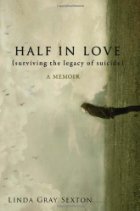
Review: Half in Love: Surviving the Legacy of Suicide by Linda Gray Sexton

I’ve literally been agonizing over this review for months now; it’s time to put it out there, even though I still don’t feel like I’ve quite gotten it “right”...

Opening lines of the book:

“Sometimes, even my bones resonate with the melodies of my childhood.

Ebullience and depression; love and warmth; the frightening separations and the joyous, if fragile, reunions. This is how I come to remember, simply because the old rhythms will always reverberate, always remain.”

Why I read it:

Years ago, when I was in my teens and early twenties, I was obsessed with the lives of Sylvia Plath and Anne Sexton, two of the earliest (and most famous) confessional poets. I read everything I could find about both of them, which in Anne Sexton’s case included her daughter Linda Gray Sexton’s first memoir Searching for Mercy Street: My Journey Back to My Mother, Anne Sexton and at least two of her novels. So I was thrilled to be offered a review copy of Linda’s second memoir, Half in Love: Surviving the Legacy of Suicide. (Some of you may also remember that I looked everywhere for this memoir at BEA least year.)

What it’s about:

As Linda says in the preface to Half in Love, her first memoir “focused on coming to terms with [her] mother’s life,” while in this book she comes to terms with her mother’s death—at the same time confronting her “own struggle with depression, bipolar illness, and [her] family’s history of successful suicides” (p. xii). As determined as Linda was not to subject her children to what she’d endured as a child—after repeated suicide attempts, Anne Sexton succeeded in taking her own life in 1974 when Linda was 21—when she reached the age her mother was when she died, Linda found herself sliding inexorably into a deep depression that led to her first suicide attempt in 1997. Half in Love is a frank and unflinching portrait of the next decade of Linda’s life as she deals with depression, nearly constant migraines, suicide attempts and cutting.

What worked:

One of the most important messages in this book is that the belief that love should be enough to overcome suicidal tendencies contributes to the passing on of a legacy of suicide: “This misperception traumatizes those who experience the loss of someone close (certain that if they had only been more worthy, their friend or family member would have loved them enough to bear the suffering), and it also becomes an obstacle for those who survive the attempt to end their own lives” (because they feel guilty and ashamed that they didn’t love their families enough not to try to commit suicide, which only adds to their suffering) (pp. 215-216). As Linda points out “it was not a question of pain versus love; in this equation the two different levels of sensation were never in competition because they were as different as a skateboard and a Mack truck” (p. 215). After reading Linda’s memoir, I almost feel like this should be obvious; yet the idea that suicidal people are selfish is widespread and deeply entrenched.

What didn’t work:

I’ve been having a hard time writing this review because much as I believe this memoir is important given how prevalent (and misunderstood) suicide is in North America,* I didn’t really like Linda’s writing style. The images she uses often fell flat or were jarring: suicide “came up from behind and took [her] in a bear hug” (p. 5); when she tries to kill herself for the first time, she “was ready to make music with the keyboard of [her] wrist” (p. 7); and when the police come to save her, they “came to [her] in a roll of thunder” (p. 9). And although she describes each cutting incident and suicide attempt in great detail, she doesn’t provide much insight into her healing process. Instead she writes vague things like: “My medications were in balance, my therapy was stellar, and my moods grew more and more stable” (p. 273).

Final thoughts:

As I was writing this review, I couldn’t help but think of a recent blog post by memoirist Dani Shapiro entitled “On Writing for the Right Reasons,” in which she quotes from an Ann Beattie short story about a writer: “He had tried to write for the wrong reason: to exorcise demons instead of trying to court them.” I wouldn’t go so far as to say that Linda is writing for the wrong reasons; however, I did get the impression that she is still exorcising her demons through her writing. This unfortunately left me feeling that I got too many details and not enough insight into her experience and recovery.

Thank you to Counterpoint Press for sending me this book for review.

*In the U.S., someone commits suicide every seventeen minutes, according to the statistics Linda provides at the end of her book.
_______________________________________________

Half in Love was on blog tour with TLC Book Tours in January and February. Visit these other blogs for reviews:

Savvy Verse & WitLife in ReviewRegular RuminationBook Club Classics!Necromancy Never PaysColloquiumRundpinneBoarding in My FortiesThe BookwormIn the Next RoomRed Headed Book ChildSuko’s Notebook

Other reviews: The Divining WandThe New York Times

Guest posts: ColloquiumShe Is Too Fond of BooksIn the Next Room

Author interview: Savvy Verse & Wit
_______________________________________________

Sunday, May 8, 2011

Review: Russian Winter by Daphne Kalotay

I’m trying something a bit different with this review: a new format that I hope will inspire me to write reviews more often!

Opening lines of the book:

“The afternoon was so cold, so relentlessly gray, few pedestrians passed the long island of trees dividing Commonwealth Avenue, and even the little dogs, shunted along impatiently, wore thermal coats and offended expressions.”

Why I read it:

I picked up Russian Winter by Daphne Kalotay at Book Expo America last year—someone had abandoned it in the convention centre. Although I was intrigued by the book’s blurb, I don’t read much historical fiction and I’m not that interested in ballet, so the book went to the bottom of my TBR pile, where it probably would have languished for a long time. However, I was inspired to read it when TLC Book Tours announced they would be touring the book.

What it’s about:

Russian Winter goes back and forth in time between modern-day Boston and Stalinist Russia. It’s primarily the story of Nina Revskaya, who at one time was a star of the Bolshoi Ballet. Now in her seventies, Nina has decided to auction her jewellery, including some pieces she brought with her when she defected from Russia. The story is also told from the points of view of Grigori Solodin, a Russian professor who owns an amber necklace that appears to match several of the pieces in Nina’s collection, and Drew Brooks, the associate director who is handling the jewellery auction.

What worked:

Part literary mystery, part historical adventure and part love story, Russian Winter is absorbing from the very first page. Kalotay’s characters are deftly drawn—all of them feel authentic, from Grigori’s late wife to Nina’s insufferable mother-in-law. The setting comes alive—I felt immersed in Stalinist Russia, an era I know very little about. Nina’s long-buried secrets kept me turning the pages, but I was just as interested in what would happen to Grigori and Drew.

What didn’t work:

I found this book engrossing from beginning to end, so not much didn’t work for me! I did find that Drew’s Russian connection felt a bit forced, like the author was trying a little too hard with the “we’re all connected” angle.

Favourite quote:

“In that way, it occurred to her, she and [X] had their work in common: behind-the-scenes, unglamorous but necessary, and best undetected. All that effort, to deliver something beautiful to the public. Of course [X]’s work took real talent, while Drew’s mainly took patience. But both were painstaking, and both required great care and the sort of focused attention that, if you allowed yourself to give in to it, and gave in to the great reward of it, became itself a form of devotion.

“The thought made Drew feel less alone, or perhaps more happily alone, sitting there cross-legged on the sofa. It was the comfort of knowing that she was not quite so strange, that there were other people who found delight in private challenges and quiet lives. People who lived in their thoughts as much as in the real, physical world. It was a reminder that true dedication to one’s work, to one’s art, was in fact—no matter how quiet or minor it might seem—a show of faith, a commitment. As for what Jen and Stephen and Kate said, that Drew spent too much time in books and in her mind, well, it was probably true. But it was also true that the internal world was an expansive one, always growing, full of possibilities that the real one did not necessarily offer.” (pp. 269-270)

Final thoughts:

I highly recommend this book, whether you are interested in ballet or not!

Thank you to Harper Collins for providing me with this book to review. (With thanks to Staci and Ana, who helped inspire my new review format.)
_______________________________________________

Russian Winter was on blog tour with TLC Book Tours in April and May. Visit these other blogs for reviews:

Library QueueLuxury ReadingnomadreaderA Few More PagesWe Be ReadingBooks Like BreathingChefdruck MusingsBook Addictionred headed book childRedlady’s Reading RoomThe Calico CriticWordsmithsoniaHistorical TapestryMan of la BookIn the Next RoomLife in the Thumb

Recommended review: she is too fond of books

Other reviews:

a book blog of one’s ownBeth Fish ReadsBookfanBooking MamaBoston Book BumsI’m Booking ItKittling: BooksLisa’s Other BookshelfMedieval BookwormMisfit SalonReading the PastRed Room Library S. Krishna’s BooksSophisticated DorkinessThe Black Sheep Dancesthe book nestThe Crowded LeafTottenville Review

Interviews with the author: Man of la BookTottenville Review

Guest posts by the author: Booking MamaBook Reporter
_______________________________________________

Thursday, March 17, 2011

Review and Giveaway: Home to Woefield by Susan Juby

Home to Woefield by Susan Juby (published in Canada under the title The Woefield Poultry Collective) is the story of Prudence, a YA-author-turned-organic-farmer, who inherits a dilapidated and scrubby farm from her Great-Uncle Harold. Delighted with this opportunity to make her dreams come true, Prudence enlists the help of several locals: Earl, the gruff 70-something foreman who came with the property; her neighbour, Seth, a celebrity blogger who hasn’t left his house since an unfortunate incident involving his high-school drama teacher; and 11-year-old Sara Spratt, who’s looking for a home for her prize-winning chickens. Told in the alternating voices of these four characters, Home to Woefield is a side-splittingly funny and thoroughly modern back-to-the-land tale.

I briefly entertained the notion that I wasn’t going to like this book—for the first few chapters, I was a bit worried that Juby was making fun of her characters, who initially seemed like they were going to be caricatures of people whose passions (organic farming and blogging) are dear to my heart. For example, Seth introduces himself like this:
“Let me paint a picture for you in words. People don’t take my skills seriously, but there’s an art to it. There really is. When I was on a roll, I used to update my blogs eight, sometimes twelve hours a day. That’s eight or twelve hours of writing. Stephen King is probably one of the only other guys who writes that much. Him and James Patterson, although King’s the only one of those two worth reading. I wasn’t creating books, but there was definitely some storytelling happening. My mother used to call my blogging mental diarrhea, and my former father, Prince of Pubs, used to ask me if I was some kind of pervert because I was on the computer so much.” (p. 8)
However, it didn’t take long for me to realize how wrong I was—as it turned out, I snorted and giggled and guffawed through the whole book (and Seth turned out to be the character that cracked me up the most). I read parts of the novel out loud to Mr. B and found myself howling with laughter all over again (who knew that sheep shearing could be so funny?). Juby’s characters are wacky and original—more than once, she retells the same moment from two or three or four points of view, each as funny as the last.

Not surprisingly, this isn’t a very realistic story—although Juby does touch on some sensitive subjects such as alcoholism and family dysfunction—but it’s hilarious, quirky and sweet. If you’re in the mood for a laugh, this is the funniest book I’ve read in a long time—in fact, I can’t remember the last time a book made me laugh so much or so hard. I highly recommend it.

Thank you to Harper Collins for sending me this book to review.
_______________________________________________

Home to Woefield is on blog tour with TLC Book Tours in March. Visit these other blogs for reviews:

Sara’s Organized ChaosBookNAround (spoiler alert) • Colloquium (spoiler alert) • A Musing ReviewsA Bookworm’s WorldRundpinneThe Lost EntwifeReviews by MollyTina’s Book ReviewsBook Club Classics!Chrisbookarama

HarperCollins Canada also organized a Woefield blog tour:

The Written WordShelf CandyDaisy’s Book JournalThe Literary WordFailing the Rorschach TestBurning Impossibly BrightMrs Q Book Addict

Other reviews:

Booking Mamafaerie writerHey, I want to read thatLeafing Through LifeRayment’s Reading, Rants and Ramblings

Interviews with the author: Daisy’s Book JournalNight Owl Reviews

Check out Phase II of the Great Hen Bag Giveaway on Susan Juby’s blog. (I want that hen bag!)

Susan Juby is going to be on Blog Talk Radio with Book Club Girl on Tuesday, April 5, at 7 p.m. ET.
_______________________________________________

Would you like to win a copy of Home to Woefield? Harper Collins has offered to send a copy to one of my readers. The giveaway is open to U.S. and Canadian residents only (no P.O. boxes). I will accept entries until 11:59 PM Eastern Time on Friday, April 8.

If you are a follower or subscriber, let me know and I will give you another entry.

Make sure you provide me with a way of getting in touch with you. Entries without a blog link or email address will be disqualified.

THIS GIVEAWAY IS NOW CLOSED.
_______________________________________________

Tuesday, March 1, 2011

Review: Devotion: A Memoir by Dani Shapiro

1. As I read Devotion: A Memoir by Dani Shapiro, I felt as if I had been waiting for this book, as if somehow Shapiro’s story was meant for me. On the surface, this is a strange notion, as Shapiro and I have little in common: I didn’t grow up in a deeply religious family, my parents are both alive, I don’t have a son who almost died as an infant (in fact, I have no children), I’m not a novelist or memoirist, I didn’t move out of Brooklyn after 9/11 to a farmhouse in Connecticut, I don’t have an impossibly difficult relationship with my mother as Shapiro had with hers. And yet, so many times I found myself nodding yes yes yes in recognition as I read this book.
“I was always racing. I couldn’t settle down. . . . I often felt a sense of tremendous urgency, as if there was a whip at my back. I was fleeing something—but what?” (p. 2)
2. “Anxious, fearful, lonely, resentful, depressed—troubled by a powerful and, some would say, deeply irreverent sense of futility” (p. 11), Shapiro decides to “climb all the way inside the questions and see what was there” (p. 12). Exploring the Orthodox Jewish traditions she grew up with, along with yoga and meditation, she seeks a middle ground between her very religious childhood and her rejection of faith as a young woman.
“Could I find and hold on to a deeper truth than the whir and strum of my daily life, which seemed designed to ensure that some day I would wake up—after the years of packed lunches and piano practice and rushed dinners—and wonder where it had all gone?” (p. 16)
3. Told in 102 short chapters or vignettes, Devotion chronicles Shapiro’s spiritual journey. Sometimes these vignettes are stories, sometimes they are barely more than single moments, flashes of the present, “moments of being,” but each is a piece of the puzzle, a stone in the stream. Inspiring, brave, funny, open-hearted and wise, Devotion invites the reader to follow Shapiro on an incredibly personal journey that will likely resonate with anyone who is searching for meaning in their own lives.
“Yogis use a beautiful Sanskrit word, samskara, to describe the knots of energy that are locked in the hips, the heart, the jaw, the lungs. Each knot tells a story—a narrative rich with emotional detail. Release a samskara and you release that story. Release your stories, and suddenly there is more room to breathe, to feel, to experience the world.” (pp. 16-17)
4. Devotion is a primer, a light shining ahead of me on the path, an inspiration to my own journey through doubt. I highly recommend it. I know I will read it again and again.*

Thank you to Harper Collins for sending me this book to review.

*I’ve already read this book in its entirety twice (and dipped in and out of it as well).
_______________________________________________

Devotion is on blog tour with TLC Book Tours in February and March. Visit these other blogs for reviews:

Kelly’s Lucky You!Book Club Classics!{Mis}Adventures of an Army WifeBooks Lists LifenomadreaderCoffee and a Book ChickColloquiumThe 3 R’s: Reading, ’Riting, and RandomnessBooks in the CityEnglish Major’s Junk FoodThe House of the Seven TailsBoarding in my FortiesMan of La BookChefdruck Musings

Other reviews:

A Design So VastBeth Kephart BooksBetween the Coverscatching daysCoffees & CommutesMostlyFiction Book ReviewsSmilin’ Buddha CabaretThe Daily Grind of a Work at Home Mom

Interviews with the author: BookPageLinus’s BlanketShambala SunSpace

Read more Devotion-style vignettes: Devotion blog

The author is also available and very enthusiastic about doing Skype chats with book clubs.
_______________________________________________


“I had stepped into a stream and was now being carried
along by an unfamiliar, powerful current.”
(Devotion, p. 29)

Reading Devotion inspired me to create the Stream of Suggestions Reading Challenge. This is my first review for this challenge.
_______________________________________________

Friday, February 11, 2011

Review: Lonely: Learning to Live with Solitude by Emily White

Lonely: Learning to Live with Solitude by Emily White chronicles White’s own battle with loneliness in her mid-thirties and provides an extensive overview of current research on loneliness, including interviews White conducted with lonely people who contacted her through her blog. Lonely is a portrait of loneliness written by someone who has experienced chronic loneliness, but it’s not a straight memoir, nor is it about “learning to live with solitude.”*

I initially found myself having a strong negative reaction to White’s personal story. In chapter 1 (called “Premonition”), White recounts how she reread the diaries she wrote at 19 in which she predicted “a life lived at a distance from everyone else” for herself (p. 17). She offers this as evidence of some sort of uncanny ability on the part of her younger self to see into the future, “as though . . . a sort of chronological porthole opened up, and I was able to catch glimpses of what my future would hold” (pp. 17-18). Her conclusion irritated me: surely it was obvious that this was a self-fulfilling prophecy! Her dismissal of yoga classes and meditation retreats as “time alone . . . commodified into something that can be bought” (p. 55) also raised my hackles. I confess I found myself feeling judgemental and impatient—and this despite the fact that I have some experience with chronic loneliness myself.

However, when White starts to investigate loneliness in an attempt to come to grips with what’s happening to her, my feelings about this book shifted and I started to feel more compassion for her story. White makes a convincing case for the fact that under the “right” circumstances anyone can become lonely, that the stereotype we have of the lonely as needy and desperate and unattractive (or worse, dangerous) is in fact not founded on reality, that loneliness is something quite different from depression and that it deserves to be studied and treated in its own right.

Although White spends a chapter defining and discussing the terms associated with loneliness, her focus is very much on loneliness as a result of isolation (which is what she experienced) and not so much on loneliness that results from not feeling connected even when you are with people (which is more the type of loneliness I’ve experienced). In addition, although she is an introvert, she barely mentions the possibility that introverts and extroverts might have different experiences of loneliness. As an introvert, my relationship to solitude/loneliness feels complicated: on the one hand, like everyone else, I need to connect with people, but on the other hand, I also need time alone—and certain types of social interactions generally don’t work for me. I would venture to guess that, at least some of the time, I feel lonely when I’m with people because I’m in a not-introvert-friendly situation. But White doesn’t seem to make that distinction: for example, her story of going on a bike trip in the hope of becoming “gregarious, embedded, fearless” (p. 159) sounds like a nightmare to an introvert—it’s no wonder the trip was a disaster. White, however, attributes the failure of this strategy solely to her loneliness, and not to introversion. More than once, it seemed to me that her discussion of loneliness could have been informed and enriched by looking at it through the lens of introversion/extroversion.

So much of the research White examines was interesting and thought-provoking and sometimes scary—I wished I had someone to discuss it with right away, especially as I wasn’t always sure I agreed with White’s conclusions. Despite the issues I had with Lonely, it makes for fascinating reading and is certainly an important book: if you have any interest at all in loneliness, I recommend reading it.

Thank you to Harper Perennial for sending me this book to review.

*The book’s original title was Lonely: A Memoir—unfortunately, neither of the subtitles is very accurate.
_______________________________________________

Lonely: Learning to Live with Solitude was on blog tour with TLC Book Tours in January and February. Visit these other blogs for reviews:

The House of the Seven TailsSophisticated DorkinessSilver & GraceBookNAroundConfessions of a BookaholicLisa’s YarnsIn the Next RoomSara’s Organized ChaosA Certain Bent Appeal

Other reviews:

BookPageBust Magazine (spoiler alert!) • S. Krishna’s Books

Guest post: In the Next Room
_______________________________________________

Thursday, December 23, 2010

Review: The Alchemist: A Graphic Novel by Paulo Coelho

The Alchemist: A Graphic Novel by Paulo Coelho is a graphic adaptation of the bestselling novel by the same name (adapted by Derek Ruiz with artwork by Daniel Sampere and others). It’s the story of Santiago, a young shepherd from Andalusia, Spain, who has a dream about a treasure buried near the pyramids of Egypt.

Several people recommended The Alchemist (in its original incarnation) to me, and I tried reading it but couldn’t get past the first few pages. When I saw that a graphic adaptation of the novel was going to be touring with TLC Book Tours, I jumped at the change to give this story another try. And I’m glad I did: the story is clever and engaging. I had just finished reading The Wisdom to Know the Difference by Eileen Flanagan (read my review), in which she talks about how we each have a purpose or calling, so this story about following your “personal legend,” as Coelho calls it, resonated with me—I read it all in one sitting (and then read it again).

However, there is also much about the book that bothered me. I suspect that some of the elements that I found confusing are probably explained more clearly in the original novel. For example, Narcissus’s story in the prologue didn’t make much sense to me (I didn’t see what it had to do with the rest of the story), nor did I see the purpose in including the page in which Santiago fantasizes about killing his sheep. I also found the section when Santiago is travelling with the Englishman to be very disjointed—the first time I read it, I thought the publisher must have made a mistake and left out several panels!

Some of my other issues had more to do with the graphic adaptation itself: I disliked the drawings of the female characters, who were either scantily clad buxom babes or (in one case) looked like a man in drag. In addition, near the end of the book, some of the text in the word bubbles is much smaller than the rest, which gave me the impression the character in question was whispering, which I don’t think was the case.

However, I also had problems with the story itself. I disliked some of the supernatural/magical elements of the tale—unfortunately, I can’t tell you more without giving some of the story away. But the biggest problem I had with the book was its sexism: Santiago needs to go out and follow his personal legend to its conclusion but Fatima finds her treasure in a man.

Overall, I’m glad I read the book, but given my reservations about it, I can’t wholeheartedly recommend it. And I can’t said that reading it has made me want to read the original novel!
_______________________________________________

The Alchemist: A Graphic Novel was on blog tour with TLC Book Tours in November and December. Visit these other blogs for reviews:

One Book Shy of a Full ShelfThe Zen LeafThere’s a BookThe Brain LairColloquiumWise Owl Book ReviewsSophisticated DorkinessJenn’s BookshelvesIn the Next RoomLove, Laughter, and a Touch of Insanitynomadreader

Other reviews: Broken FrontierThe Books in My Life

Read an excerpt from the book: Graphic Novel Reporter
_______________________________________________

Thursday, December 16, 2010

Review: The Wisdom to Know the Difference: When to Make a Change—and When to Let Go by Eileen Flanagan

You are probably familiar with the Serenity Prayer: “God grant me the serenity to accept the things I cannot change, the courage to change the things I can, and the wisdom to know the difference.” In The Wisdom to Know the Difference: When to Make a Change—and When to Let Go, Eileen Flanagan, a leader in her Quaker community, attempts to answer the question: How do we develop the wisdom to know the difference between the things we can change and the things we cannot? Using her own experiences and challenges as well as the stories of people she interviewed from a diversity of spiritual/religious backgrounds, Flanagan structures her answers around seven spiritual lessons: “The Courage to Question,” “Knowing Yourself,” “Seeking Divine Wisdom,” “Shifting Your Perspective,” “Practicing Loving Acceptance,” “Letting Go of Outcomes” and “Finding Wisdom in Community.” Each chapter includes an exercise as well as a series of questions to reflect on. The focus of this book is both personal and global: Flanagan examines how we can make changes (or accept what we cannot change) in the wider world as well as in our personal lives.

I was a bit worried that this book would be too Christian or too preachy for my tastes, but that was far from the case. In fact, Flanagan demonstrates that the spiritual lessons in this book can be applied by anyone, whether Christian, Jewish, Muslim, Buddhist or simply a believer in a higher power. There were only a few stories that made me slightly uncomfortable (specifically the ones of people who had heard the voice of God).

While reading The Wisdom to Know the Difference, I had an “aha” moment about the importance of accepting the way things are before you can figure out whether or not you can change them. In one particular area of my life, I had been yearning for the way things were instead of coming to terms with the way things are now, which has made it very difficult for me to see my options with any clarity (having things return to the way they were is obviously not an option). Already, letting go of what was has made a difference—and has shifted the way things are in a positive way. It was worth reading this book just for this insight.

Another point Flanagan makes that has gotten me thinking is that each of us has a purpose or calling. As Flanagan says, “While getting in sync with this loving design does not mean that you will be giddy with joy every minute of the day, finding your purpose often brings both serenity and courage, not to mention clarity about what you should try to change and what you should just let go of and accept”
(p. 85). I have known for a while that I’m not “in my lane” (to borrow a metaphor Flanagan uses), but reading this book has prompted me to reflect further on the fact that I don’t know what or where my lane is—among other things, I’m hoping the Discernment Exercise Flanagan proposes in chapter 3 will help with this.

Finally, there was one passage in the book that particularly stood out for me:
“Disciplined spiritual practice can be one of the benefits of being part of an organized religion or a community like AA. For those who have rebelled against the rigidity or sexism of a traditional religion, it can be tempting to adopt the comforting or fashionable aspects of various traditions, while avoiding the hard parts. You may wear Buddhist beads, attend a Native American sweat lodge, visit a friend for Passover, or go to church on Christmas, but never participate in a community that challenges your False Self. In fact most religious traditions have practices that are difficult, like tithing or fasting, which are meant to strip away your selfish parts and develop qualities like gratitude and compassion. By practicing one tradition deeply you can benefit from such challenges, which can also help to transform your attitude.” (p. 145)
Because I grew up in a secular household—we didn’t even go to church on Christmas or Easter—I haven’t exactly rebelled against a specific set of beliefs. However, I have certainly been a dabbler, trying out elements of Eastern spirituality (yoga, Zen Buddhism, mettā) and flirting with Unitarian Universalism and neopaganism at various points in my life. When I was younger, I shied away from joining any type of spiritual or religious community for fear of censure and constraint; recently the benefits of both regular practice and community have become more obvious to me—and Flanagan’s words are a further nudge in that direction.

The Wisdom to Know the Difference is an insightful and thought-provoking book that deserves to be read slowly and reflected upon in depth—something I didn’t have time to do as much as I wanted to before writing this review. I highly recommend this book—it’s definitely one I will be rereading.

Thank you to Eileen Flanagan for sending me this book to review.
_______________________________________________

The Wisdom to Know the Difference is on blog tour with TLC Book Tours in December and January. Visit these other blogs for reviews, interviews and giveaways:

Patricia’s WisdomConstantly Evolvingarriving at your own doorAwake Is Good (interview) • Serenity & StyleAlways Well Withinemilyism.comEvolving BeingsLiz LamoreuxEvenstar ArtEnchanted OakI’m just F.I.N.E.change therapyKnowing the Difference

Other reviews:

Book FetishGuinevere Gets SoberNew Consciousness ReviewThe Power of SlowSpirituality Practice

Guest posts or articles:

“Living the Serenity Prayer” @ beliefnetGuinevere Gets Sober“How Religion Changes Lives” @ The Huffington PostWithout Wax

Interviews with the author:

The Creative CompetitorEmbody Your VisionLynn Dove’s Journey ThoughtsBeyond BlueRead the SpiritSelling BooksShe WritesThe Social Work Podcast (with transcript)
_______________________________________________

Thursday, October 28, 2010

Review and Giveaway: The Gifts of Imperfection by Brené Brown

I almost didn’t request a review copy of The Gifts of Imperfection: Let Go of Who You Think You’re Supposed to Be and Embrace Who You Are—Your Guide to a Wholehearted Life by Brené Brown because I really dislike the cover; however, the book’s subtitle called to me. Then I read the back blurb, which includes this passage:
“Brown explores how we can cultivate the courage, compassion, and connection to wake up in the morning and think, No matter what gets done and how much is left undone, I am enough, and to go to bed at night thinking, Yes, I am imperfect and vulnerable and sometimes afraid, but that doesn’t change the truth that I am worthy of love and belonging.”
And I knew I had to read the book. I cannot tell you how often I stress about the things I’ve left undone, not to mention feeling paralyzed by my own perfectionism. Brown is a researcher who has dedicated much of her career to studying shame, empathy, fear and vulnerability; in listening to people’s stories, she started to identify what she called wholehearted research participants, i.e. people who were leading amazing lives by “living and loving with their whole hearts.” This prompted her to ask “What did these folks value? How did they create all of this resilience in their lives? What were their main concerns and how did they resolve or address them? Can anyone create a Wholehearted life? What does it take to cultivate what we need? What gets in the way?” To answer these questions, Brown came up with 10 guideposts to wholehearted living: cultivating authenticity (letting go of what people think); cultivating self-compassion (letting go of perfectionism); cultivating a resilient spirit (letting go of numbing and powerlessness); cultivating gratitude and joy (letting go of scarcity and “fear of the dark”); cultivating intuition and trusting faith (letting go of the need for certainty); cultivating creativity (letting go of comparison); cultivating play and rest (letting go of exhaustion as a status symbol and productivity as self-worth); cultivating calm and stillness (letting go of anxiety as a lifestyle); cultivating meaningful work (letting go of self-doubt and “supposed to”); and cultivating laughter, song, and dance (letting go of being cool and “always in control”).

Here are some of the things that stuck with me:

1. Brown talks about writing a blog post on the “‘dig deep’ button,” which she defines as “a secret level of pushing through when we’re exhausted and overwhelmed and when there’s too much to do and too little time for self-care” (p. 3). She turns this concept on its head, explaining that when wholehearted people get exhausted, they get:
  • Deliberate in their thoughts and behaviors through prayer, meditation, or simply setting their intentions
  • Inspired to make new and different choices
  • Going: They take action
Ironically, while I was writing this review, I realized that I was relying on my own “dig deep” button, soldiering on and pushing through even though it was past two in the morning. (I think I already need to reread this book!)

2. Brown talks about how “one of the greatest (and least discussed) barriers to compassion practice is the fear of setting boundaries and holding people accountable” (p. 16). As she points out, “When we fail to set boundaries . . . we feel used and mistreated. This is why we sometimes attack who [a person is], which is far more hurtful than addressing a behavior or a choice” (p. 19). This makes sense to me and yet I find it very hard to practise. (Why is it so scary to set limits?)

3. According to Brown, “the . . . one thing [that separates] the men and women who [feel] a deep sense of love and belonging from the people who seem to be struggling for it . . . is the belief in their worthiness” (p. 23). This finding is a bit depressing because for those of us who struggle with feeling worthy it’s such a catch-22: I feel like I don’t belong because I feel unworthy of belonging; I feel unworthy of belonging because I feel like I don’t belong. Although there are no easy answers, Brown does offer some hope: it is possible to cultivate a sense of worthiness by sharing our stories and letting go of our attachment to what other people think.

4. Brown describes herself as a “take-the-edge-off-aholic,” a concept that resonated for me. She says she can definitely say “today I’d like to deal with vulnerability and uncertainty with an apple fritter, a beer and cigarette, and spending seven hours on Facebook” (p. 72). My own numbing tools of choice (some of which veer towards addiction) are food, the Internet, television, sleep, lack of sleep, book buying, reading and busyness. And the funny thing is that in the middle of writing this review, when I was feeling stuck and vulnerable and my negative self-talk was starting up with the How could you leave this to the last minute again?, I procrastinated by watching Brown’s TEDxHouston talk, and it was only when she said “We numb vulnerability” that I realized that I was avoiding my own feelings of vulnerability by watching this video! (Listening to this talk is a great introduction to the concepts she discusses in this book and will give you a very good idea of whether this book is for you.)

5. Brown’s research shows that, “Without exception, spirituality—the belief in connection, a power greater than self, and interconnections grounded in love and compassion—emerged as a component of resilience” (p. 64). She also found that, “Without exception, every person [she] interviewed who described living a joyful life . . . actively practiced gratitude and attributed their joyfulness to their gratitude practice” (p. 77-78). I’m still at the point where I have what she calls “an attitude to gratitude”: it’s something I think about, but not something I practise (at least not yet).

My only complaint about this book is that I wish it was longer (it’s only 130 pages excluding the endnotes): I wanted more stories and more details about who the wholehearted were. I also found that her final chapter about the research process was a bit short on details: it didn’t satisfy the sociologist* in me. Having said that, if any of the concepts she discusses resonate with you in any way, I highly recommend this book!

Thank you to Hazelden Publishing for sending me this book to review.

*I have a BA in sociology.
_______________________________________________

The Gifts of Imperfection was on blog tour with TLC Book Tours in September and October. Visit these other blogs for reviews:

Silver and GraceSimply Stacieevolution youPatricia’s WisdomLiving Outside the Stacksthis full houseoverstuffedFrom Marriage to MotherhoodRundpinneCynthia Lou

Read an excerpt from the book: Sober 24
To practise some of the things Brown writes about, participate in her Perfect Protest (watch the Protest Dance on the Being Joy blog for inspiration) and/or confess something imperfect about yourself on Karen Walrond’s Chookooloonks blog.

Visit Brené Brown’s blog: Ordinary Courage
_______________________________________________

Would you like to win a copy of The Gifts of Imperfection? Hazelden Publishing has offered to send a copy to one of my readers. The giveaway is open to U.S. and Canadian residents only (no P.O. boxes). I will accept entries until 11:59 PM Eastern Time on Thursday, November 18, 2010.

For one entry, please let me know why you are interested in reading this book.

If you are a follower or subscriber, let me know and I will give you another entry.

Make sure you provide me with a way of getting in touch with you. Entries without a blog link or email address will be disqualified.

THIS GIVEAWAY IS CLOSED.
_______________________________________________