Showing posts with label Brogan’s reviews. Show all posts

Friday, March 23, 2012

Brogan’s Review: Curiosity by Joan Thomas and Remarkable Creatures by Tracy Chevalier

My sister Brogan, who guest reviews on this blog on a semi-regular basis, sent me a batch of her reviews recently. Here’s the first of them...

I first heard about Mary Anning by reading a (nonfiction) children’s book with my daughter called Mary Anning and the Sea Dragon by Jeannine Atkins. Mary was a young girl in early 19th-century England who dug for fossils and sold them. She discovered a dinosaur before anyone knew what such a thing was—in fact before the word “dinosaur” was coined—and spent the better part of a year at the age of 12 uncovering an entire skeleton. She never married, and she continued to make a living by digging for fossils in her native Lyme Regis.

When I saw Curiosity by Joan Thomas on the library
shelf one day, I was immediately drawn to an adult version of the story, even though the subtitle, “a love story,” perplexed me somewhat, because Mary never married (not that love equals marriage!) and the Jeannine Atkins book suggested a quirky, possibly lonely character in Mary. Well, whatever the case, I definitely wanted to read more about this eccentric woman who was unusual for her time and place.

Before I had a chance to read Curiosity, I also came across Remarkable Creatures by Tracy Chevalier. Well, then I was doubly curious, to think that 2010 brought forth two books about Mary Anning! Chevalier’s take is a little different: she offers the story of an uncommon friendship between two women of vastly different backgrounds and classes: Mary Anning, who came from a family struggling to keep clothed, fed and sheltered, and Elizabeth Philpot, who, though on the downturn of a moneyed family, needed neither to work nor to marry to live comfortably. I was just as eager to read Remarkable Creatures, since women’s friendships are an even stronger draw for me than love stories.

I started with Curiosity, which didn’t draw me in right from the start, as I found it particularly cerebral and hard to follow. But after the first hump I was really caught up in the story, its characters and its detail. I can only describe it as elegant. Joan Thomas plumbs the depths of 19th-century English classism and sexism in this novel, and renders complex characters with conflicting motivations. Here’s an early passage in Curiosity to give you an idea of the language and richness of description that Thomas achieves:
Mary sat and watched her father as he took up the second drawer and began to fit it together. He was working from the light of the window, which showed the sky in three rows of its panes, and then the sea. In the soft sawdust on the floorboards, she could see his footprints like the tracks of animals on the shore. This was a collecting cupboard he was making, with shallow drawers for the curiosities. For the rich, who could afford to hoard what the Annings must sell. It was a strange passion with the high-born, filling their drawing rooms with thunderbolts and snakestones, although they could buy all the china figurines they chose. Richard was lining up the dovetails, bracing the drawer on the workbench. He needed a helper. But he’d apprenticed [Mary’s brother] Joseph to Armstrong the upholsterer on Dorcas Lane. (Curiosity, p. 13)
Remarkable Creatures is much more accessible—there was never a point in the text when I wasn’t sure if I understood what was actually happening—but it also had a tendency towards cliché. Chevalier, it seems, never has a character hold anything back. They speak out, they speak up, they make much drama, but ultimately this is neither very believable, nor in fact very interesting. Mary is constantly in need of rescue in various forms (and always from the more-than-obliging Miss Philpot).

Chevalier misses the boat completely as far as class analysis goes and almost has her own brand of classism towards the Annings: I was irritated that Mary’s father is depicted as a carpenter of poor workmanship, when, really, how long would you last as a craftsperson in a small town if your work was of poor quality? Was it just too hard for Chevalier to imagine that economic structures of the time, and not personal failure, were to blame for the Annings’ poverty? And then when Mary sells her first big find, Miss Philpot comes and instructs Mary’s mother and older brother to invest the money in an apprenticeship for him for a trade—as though only an educated, higher-class woman would have the forethought for such decision-making—and yet the likelihood of someone of a higher class speaking of such private matters with a family seemed quite low to me.
When Lord Henley paid us £23 for the whole crocodile, I wanted lots of things. I wanted to buy so many sacks of potatoes they’d reach the ceiling if you stacked them. I wanted to buy lengths of wool and have new dresses made for Mam and me. I wanted to eat a whole dough cake every day and burn so much coal the coalman would have to come every week to refill the coal bin. That was what I wanted. I thought my family wanted those things too.

One day Miss Elizabeth come to see Mam after the deal had been done with Lord Henley and sat with her and Joe at the kitchen table. She didn’t talk of wool or coal or dough cakes, but of jobs. “I think it will benefit the family most if Joseph is apprenticed,” she said. “Now you have the money to pay the apprentice fee, you should do so. Whatever he chooses will be a steadier income than selling fossils.” (Remarkable Creatures, pp. 111-112.)
It was a strange experience to read two books with the same characters, not just Mary Anning and Elizabeth Philpot but a whole cast of characters in the town (with some exceptions) as well as the men who come from London to study the fossils. It’s a rare event to have two books cover so much of the same territory—I doubt both these books would have been published had they not come out nearly simultaneously, for whoever wrote the second book would surely have been accused of copying the first. (I do wonder whether Joan Thomas and Tracy Chevalier ever crossed paths in London or Lyme Regis while doing their research… that seems like a story in itself!)

I read Curiosity first, so it did feel to me like Joan Thomas raised the bar, and then Tracy Chevalier—for all that she may be the better known of the two writers—just didn’t hold a candle to Thomas’s achievement. I was interested, though, in the similarities and differences between each rendition. For example, the love story seemed so truncated in Joan Thomas’s book—were 19th-century men really so totally lacking in sexual imagination? However, when it was told in such a similar fashion in Tracy Chevalier’s book—though she chose a different character as the romantic interest—I felt more forgiving of Joan Thomas’s text. But perhaps it should just make me further question whether it’s 19th-century men who lacked imagination or rather 21st-century women writers when imagining 19th-century sex! The bigger question, of course, is about how sex is represented in literature and in our lives as women, which I can’t explain in more detail here without spoilers, but which I think deserves further exploration.

I would highly recommend Curiosity, even though I know it won’t be everyone’s cup of tea, as it is quite literary and brooding; and I would not recommend Remarkable Creatures. If you’re into children’s books or have a child to read to (ages 7 to 10), Mary Anning and the Sea Dragon by Jeannine Atkins is a beautiful illustrated book and introduces several interesting topics for conversation.
_______________________________________________

Other reviews of Curiosity:


Other reviews of Remarkable Creatures:

_______________________________________________

Thursday, October 27, 2011

Brogan’s Review: Half of a Yellow Sun by Chimamanda Ngozi Adichie

Hmm, it seems like the only person writing reviews for my blog these days is my sister Brogan! Here’s another one for you while I’m away...

I find myself not wanting to say anything critical about Half of a Yellow Sun by Chimamanda Ngozi Adichie because it’s so good, and not only is it a good book, but it’s also an important one. The story is set in Nigeria in the sixties and alternates between “the early sixties” and “the late sixties.” It begins by introducing the main characters, Olanna and Kainene, middle-class twin sisters, Olanna with a revolutionary bent and Kainene with a more business orientation. Olanna has a lover, Odenigbo, who is a university professor; Kainene’s lover is a white man from England, one of the few Westerners who has come to Nigeria not to pillage the country but to try to understand it (he is interested in the historical art of the area). Then there’s Ugwu, Olanna and Odenigbo’s household servant, a poor boy from an outlying village who is trying to make his way (preferably up) in the world.

Enter civil war.

The power of this book for me was twofold: one, it totally transported me to another world, a world of jollof rice, houseboys, and multiple languages and ethnic groups (Igbo, Yoruba, English, Fulani and a number of others); and two, despite their obvious differences at the outset, I saw how similar middle-class Nigerian life could be to middle-class North American life, and therefore as I read about the anomie of war I could imagine and dread my own life being so transformed. This is the greatest strength of Half of a Yellow Sun: it makes you care about people who live half a world away, people whose lives are entwined in our own, given that so many resources that support our middle-class lifestyle come from Africa.

I cared deeply about the characters, who are strong, uncompromising and interesting. When Olanna described being afraid of who would die next, I can only say that I shared her fear.

Knowing that this novel is based on actual events made me want to learn more about the history of Nigeria and the struggle for an independent Biafra. (Adichie gives free reign to a number of political discussions in the book, but since she’s faithful to actual conversations, people do not reference their current political situation with the in-depth background information that would have been helpful to someone like me, who knew nothing about the political history of the area and had only a sketchy knowledge of international politics at that time.)

One thing this book made clear was that in such wars, it is not the side with the most legitimacy that wins, or the side with the deepest conviction among its supporters—it is rather the side with the backing of Western powers (and therefore access to weapons), a support that can depend on the vagaries of international relations at the time. But also, that in war there is no “good side,” and the tools of war are brutality on both sides. The war in Nigeria against secessionist Biafra was the first conflict in which mass starvation was deliberately used as a weapon of war (against the Biafrans).

My questions or slight detractions about the book are more on the personal, character level. For instance, one of the women, Kainene, is said to be ugly and is frequently compared to her beautiful sister (by other characters) because they are twins. As a reader, I cared about Kainene’s ugliness, about how this single fact of her life (which she could do nothing about) affected her and how she reacted to it with wryness and sarcasm. However, I also didn’t quite understand it—Adichie writes of “beautiful” and “ugly” as if they are absolute and universal, as objective as describing one person’s eyes as brown and another’s as blue. But beauty is not an objective quality so I found myself wondering what was ugly about Kainene? Adichie only ever describes this ugliness in the vaguest of terms, using words such as “androgynous” and “skinny”—she gives us no details. (She gives no details as to the beautiful woman’s looks either but somehow this mattered less.) Also, both Western and Nigerian men find Kainene unattractive, which, given that standards of beauty are culturally specific, made me wonder further: what is it about this woman’s appearance that so sets her apart? Because Adichie doesn’t explore these details, it seemed to me that she used Kainene’s ugliness as a device and in that way I felt the telling wasn’t compassionate. Casting Kainene as ugly seemed like an idea imposed on the character rather than an organic part of her reality, which I hope would have led to a more sensitive and complete exploration of that reality.

Overall, Half of a Yellow Sun is a phenomenal book. Part love story, part examination of war, it doesn’t evade subtleties (it’s not because you are surrounded by shelling that you know for sure whether you’ve chosen the right lover), nor does it turn away from looking at the crassness of humanity at its worst—which is war—and how ordinary people live their lives in the midst of it.
__________________________________________________

Other reviews:

Book Chatter • Caribousmom • Musings of a Bookish Kitty • pages turned • she reads novels • SmallWorld Reads • The Magic Lasso
__________________________________________________

Thursday, August 18, 2011

Brogan’s Review: The Devil That Danced on the Water: A Daughter’s Quest by Aminatta Forna

This is the second of two reviews by my sister Brogan that I’m posting during my vacation...

Whenever my grandfather arrived he seemed to materialize out of nowhere. Although I’m sure he must have carried his clothes in a bundle, he never appeared to have anything resembling luggage. And when he walked into the compound there was no evidence of the means of transportation he had taken, no bush taxi disappearing in a whirl of dust, no car or bus. Not even a bicycle. He looked as though he had just come from the end of the road instead of Magburaka, where he lived, a whole day’s travel away. By necessity, since there were no telephones and no mail service to speak of, he arrived unannounced and would stay for a few days or sometimes a few weeks.
[. . .]
Pa Roke wore mukay, pointed leather shoes, that men used as slippers with the back trodden down. He would slip them off and cross his bare feet at the ankle. Likewise my father took off his sandals. This signaled the beginning of their sessions. They talked for hours together in Temne, who knows what about, since I couldn’t understand a word they said. (pp. 50-51)
Some books just take you away, out of your day-to-day world and into a world of different colours and events than anything you know. Even though the subject matter is difficult, The Devil That Danced on the Water: A Daughter’s Quest by Aminatta Forna was one of those books for me. Forna tells the true story of her father, Mohamed Sorie Forna, who was executed in 1974 in his native Sierra Leone. He was a prominent former Minister of Finance of the country, part of its first democratically elected, post-independence government in the late sixties. Forna was 10 when she lost her father, and much of the book is devoted to her vivid memories of him before he was taken as well as of her childhood in Africa (mostly in Sierra Leone) and Great Britain (mostly in Scotland).

The book goes back and forth in space and time, but Sierra Leone is its real anchor, and the stories of Forna’s life there are the ones that really felt like they transported me to a different, yet not alien, reality. I loved the scene where Forna and Milik, the cook, discuss storytelling and conventions of storytelling (morals of the story are quite different in African stories), and when Forna can’t figure out why the story Milik has just told doesn’t meet with her European sensibilities, he says, by way of ending the conversation: “You wouldn’t go back to find a devil. Just like you wouldn’t buy a dead chicken.” Some months later, Aminatta tells her grandmother in Scotland she shouldn’t buy dead chickens, and her grandmother, a little startled, asks, “Whatever makes you say that, dearie? You don’t think I’m going to kill it myself, do you?” (pp. 134-135). The cultural reference points are so different that it makes perfect sense not to buy a dead chicken in Sierra Leone, but what else would you do in Aberdeen? Because Sierra Leone is her homeland, Forna doesn’t turn it into exotica, neither romanticizing it nor condescending to it in any way.

The story itself is multi-layered. It’s a political story, of a man who was a doctor and became a politician for all the right reasons, who was eventually executed by the very prime minister who made him part of the government. It’s a personal story, of a girl whose father was taken from her without explanation and without his resistance, a child whose life already included being part of three different family configurations—along with her two siblings, she lived with her parents while they were together, then with her mother in Scotland, and then with her father and stepmother in Freetown, Sierra Leone. It’s a story about culture, about multi-generational, non-nuclear, sometimes polygamist family structures, and the Africa of ordinary people. And finally, it’s a story of government corruption, the whys and wherefores of the execution of 15 men, the botched trial, the motivations of those who lied and created lies to serve their own purposes.

The one aspect that detracted from my enjoyment of this book was when Forna applies her journalist’s dedication to tracking down all those involved in her father’s trial. I just could not keep track of the many many witnesses she interviewed, nor of their exact relationship to the story. I sympathized with her need to be thorough and her need for a moral evaluation of the players (what did they do, and were they sorry about it?), but at a certain point I just couldn’t follow them all anymore.

I wondered if I would even be able to read this book, because the mere words Sierra Leone inspire a shudder in me, given my knowledge of the recent atrocities during the civil war in that country. However, I actually think my capacity to read about such events has been increased by reading The Devil That Danced, and I’m not sure there’s an entirely rational reason why, other than the opening of the heart that happened to me while reading this book. For one thing, I now feel like I care about this country in a different way, and for another, Forna’s description of her trip back to Sierra Leone during the war and of a couple she met then who are both war amputees made the horrors of war come down to a more individual, more compassionate level.
_______________________________________________

Other reviews:

GhanaWeb • The life and times of a Heather
_______________________________________________

Friday, August 12, 2011

Brogan’s Review: Still Alice by Lisa Genova

This is the first of two reviews by my sister Brogan that I’m posting during my vacation.

“If the piece of notebook paper with her mother’s recipe on it still existed, Alice didn’t know where it was. She hadn’t needed to refer to it in years. It was a simple recipe, arguably better than Marty’s cheesecake, and she’d made it every Christmas Eve since she was a young girl. How many eggs? It had to be more than six, or she would’ve taken out only one carton. Was it seven, eight, nine?
“She tried skipping over the eggs for a moment, but the other ingredients looked just as foreign. Was she supposed to use all of the cream or measure out only some of it? How much sugar? Was she supposed to combine everything all at once or in a particular sequence? What pan did she use? At what temperature did she bake it and for how long? No possibility rang true. The information just wasn’t there.

“What the hell is wrong with me?

“She revisited the eggs. Still nothing. She hated those fucking eggs. She held one in her hand and threw it as hard as she could into the sink. One by one, she destroyed them all.” (pp. 65-66)
Lisa Genova’s ear for the Alzheimer’s patient’s experience in Still Alice is impeccable. Although I’m not particularly familiar with the details of such an experience, this fictional version rang true to me. So true, in fact, that it was spooky. When I put the book down halfway through and couldn’t remember who had recommended it to me, I was unusually disturbed, actually distressed, until it finally came back to me.

Alice is a successful and driven Harvard professor in psycholinguistics when she is diagnosed with early onset Alzheimer’s disease at the age of 50. We meet her before her personality has been impacted, and the book follows her month by month (each chapter is a new month) as the disease and her life progress. We get to know her husband and her three grown children, and we also follow her to medical appointments, which orients the reader in terms of Alice’s deterioration, as well as providing information about the disease itself.

Genova’s writing reminds me in parts of Margaret Laurence (whom I admire greatly). In the following passage, Alice, who is about to go for a run with her husband, has gone back into their summer home, but she can’t remember why. She begins to retrace her steps to try to remember, thinking (twice) it may have been for her fleece, but never coming to the real reason for her back-track. Eventually she gives up and heads back out, when:
“Just as she reached the front door, an urgent pressure in her bladder announced itself, and she remembered that she really had to pee. She hastened back down the hall and opened the door to the bathroom. Only, to her utter disbelief, it wasn’t the bathroom. A broom, mop, bucket, vacuum cleaner, stool, toolbox, lightbulbs, flashlights, bleach. The utility closet.” (p. 149)
These startling moments have such perfect tempo and are so imaginable that they are simply chilling, even though nothing like them has ever happened to me.

What worked less well for me were some of the plot elements in the book, particularly aspects of the ending, which also felt like it happened too quickly. By the end of the story, Genova seemed unsympathetic or at least not attuned to Alice’s husband, John. In addition, some of the sibling dynamics between Alice’s children felt forced.

The speed of the ending and the lack of empathy for John may have been inevitable, given that Genova gave herself the near-impossible task of telling the story from Alice’s point of view, and Alice’s vision of what is going on around her becomes less and less coherent with time, as does her understanding of what is happening within her. In that way the last third of the book reminded me of Flowers for Algernon by Daniel Keyes, where the telling remains sympathetic but the distance between reader and narrator increases to the point where it stops being in any way familiar.

However, Genova never loses sight of Alice—her telling is absolutely faithful. The stories she chooses to tell about what happens to Alice are stories of the human heart’s capacity to love. And yes, this book will make you cry. Several times.

I am left thinking about what Still Alice is meant to leave with its readers. Yes, it is an injunction to be more sympathetic towards Alzheimer’s patients and to consider them as full human beings in spite of their impairments—she is, still, Alice. Also, Genova is clearly bent towards a vision that medical solutions will eventually eradicate or transform this disease. But more than that, Still Alice is about the heart, about the particular displacement of self that love is, its flows and its allowances, whether it is love for one’s parent, one’s spouse, one’s children, or even, oneself.
_______________________________________________
Other reviews:

Bibliophile by the Sea • Books on the Brain • Daisy’s Book Journal • Life in the Thumb • Life... with Books • Musings of a Bookish Kitty • Reading on a Rainy Day • The Infinite Bookshelf
_______________________________________________

Friday, May 13, 2011

Brogan’s Review: Cool Water by Dianne Warren

It’s been a while since I’ve posted one of my sister Brogan’s reviews. Here’s her latest, a review of Cool Water by Dianne Warren.

I was really drawn to Cool Water by Dianne Warren. It wasn’t the cover, it wasn’t the title, it wasn’t even the opening paragraph. What got me was Fred Stenson’s blurb on the back cover: “That two people can share a house and not know they love one another; that a note in a pocket with a woman’s name on it can crack decades of trust—this is a novel about the isolation that we hold secret within ourselves . . . It tiptoes the fine edge between joy and weeping.”

Cool Water is set in a small Western Canadian community, the fictional town of Juliet, Saskatchewan, where a cast of characters set the tone and rhythm of the novel’s unfolding with hardly a hand wave in the direction of plot. Through a series of coincidences, several characters are all insomniac on the same night, as the book opens. The story then traces the next day as the townsfolk live out personal dramas and interact with each other.

The central character is Lee Torgeson, who neatly circumscribes the story by spontaneously stepping out of his habits and obligations, taking off on a lost horse and riding into the night and through the next day, reflecting on life in Juliet and his recent loss of both his adoptive parents. While this wander seems unlikely, it also allows for lengthy musings and the view of an outsider on a place that is his own, but also isn’t.

I tend to read character-driven stories, so Cool Water is right up my alley. I also like multiple viewpoints, criss-crossing subplots, and a little bit of local taste and colour. Because I live in a small town, I understand how life can feel like a play sometimes, as well as a gossip-mill, and I like reading a fictional version done well, where characters’ interior lives are complex and idiosyncratic, and their interactions are sometimes deceivingly superficial and banal. All of these aspects are pluses for Warren’s novel.

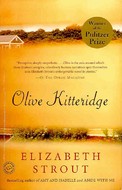
The book reminded me of two other books: Sounding Line by Anne DeGrace, and Olive Kitteridge by Elizabeth Strout. Sounding Line had the same small-town feel and fixtures: in Sounding Line, it’s a café and the people who run it; in Cool Water, the hardware store and the woman who works at the post office. These are the places around which the towns orient themselves, with all their various characters; these are the reference points that touch everyone, the hubs of activity, the channels of information. Sounding Line is set in a fictional Nova Scotia town and was inspired by the events surrounding a UFO sighting in the real town of Shag Harbour in the sixties. Primarily, though, the book is a character exploration, centred on a boy losing his mother to cancer.

Olive Kitteridge by Elizabeth Strout is in this same style, although it’s a grouping of short stories and so doesn’t have the same effort towards a narrative line as the other two. Olive Kitteridge is set in a small town in Maine and follows both the life of Olive Kitteridge, a somewhat curmudgeonly now-retired schoolteacher, as well as the lives of a cast of characters who happen to live in the same town. The interconnected stories all mention Olive at least in passing, but are not necessarily about her in any significant way and don’t necessarily return to the same characters at any other point in the book, other than several about Olive and her husband Henry.

The challenge of such books is to create a world that feels authentic in its ordinariness, but has enough going on in it to make it interesting to read about. The first half to three-quarters of Cool Water succeeds in this venture admirably. The characters and their evolutions are delightfully understated, yet interesting—I think of the woman, mother of six kids, who swears she’ll put up the beans the next day, only to get up and find a pretext to go to town—and it’s so clear she’ll never get back in time to do the beans. I found myself relating to this character so much in this struggle that I truly don’t know if it was more funny or sad.

The problem with Cool Water is that at some point Warren decides to start making an ending for it, and as she ties up each character’s story, she loses something of the finesse of her craft, which was in listening to the characters and letting them drive the story forward. Instead, the changes they undergo towards the end seem sudden or unbelievable, or the denouement is just too self-conscious—which is jarring for a reader who was believing in the characters as people, to suddenly feel like they don’t “smell right”—that the author just needed to finish their stories.

In the end, I think Cool Water was more enjoyable in the reading of it than in thinking about it after the fact—it just doesn’t have that much to stay with you at the end of it, which is unfortunate for a book that initially had such perfectly executed emotional tensions.

Cool Water won the Governor General’s Literary Award for Fiction in 2010.
_______________________________________________

Other reviews:

A Bookworm’s World • Caribousmom • Curled Up with a Good Book and a Cup of Tea • Daisy’s Book Journal • Kate’s Bookcase • KevinfromCanada • Lindy Reads and Reviews • The Book Chick • The Gleeful Reader • The Indextrious Reader • Wise Monkeys

Guest posts by the author: A Bookworm’s World • The Book Chick • The Gleeful Reader

Interview with the author: Read, Play, Blog
_______________________________________________

Friday, January 7, 2011

Brogan’s Review: Arlington Park by Rachel Cusk

It’s been way too long since I’ve posted one of my sister Brogan’s reviews. Without further ado, here’s her review of Arlington Park by Rachel Cusk.

I picked up Arlington Park because I’d read another book by Rachel Cusk, A Life’s Work: On Becoming a Mother, which I found quite interesting and which made me want to read one of her novels. Arlington Park is set in an upscale London suburb by the same name and follows the lives of a few families in the neighbourhood—particularly from the women’s point of view—without any particular thread between them, other than the occasional meeting or dinner date. It takes on their varying levels of disgruntlement with, and understanding of, their lives as they are.

I was reminded of Virginia Woolf’s To the Lighthouse in the way that Arlington Park is written, dramatically yet dispassionately, very “third person,” sometimes flowing into a description of the weather or the street without any connection to character at all. Also in a similar way to Woolf, Cusk at times zooms in on a small detail or a moment that becomes metaphorical even to the characters as they are living an experience:
“She gave Amanda a raffish smile with her yellowed teeth. Her small blue eyes in their striated pockets of skin twinkled with suggestion. Sometimes Amanda had seen her and Max going out for the evening and Jocasta looked beautiful. The sight of her then caused Amanda to feel that there were certain people she lacked the ability to perceive, just as she often failed to see in famous paintings what it was that they were famous for. It gave her a sensation of instability, like vertigo.
‘We’re just boring,’ Amanda said.
Jocasta looked astounded and slightly embarrassed by this reply.
‘Oh, darling!’ she cried. ‘You’re not boring—nobody’s boring! I didn’t mean to suggest that at all, you poor thing!’” (p.55)
Each chapter introduces a new character and a new point of view, until about three quarters of the way through when Cusk brings us back around to some familiar names. This rhythm feels comfortable. The different characters are all almost equally interesting, and I found myself reassured by the return of some of them so I could situate myself and return to people I cared about. However, I did find myself wanting more of them… not just in a good way, of wanting more of the book after it ended, but also wanting something more of significance. Why give us these characters, some of whom we come to care about, if they are nothing but solitary, singular, strange? What was Cusk trying to say about them, or about modern life? I felt like there was something more, and it didn’t ever manifest; she was on the cusp of saying something, but she stopped.

Some of the characters (Liz, Christine) are rather vacuous, which Cusk presents as a not-too-positive aspect of this suburban existence, but in her keenness to present them without judgement, I found myself wondering at some points how much I wanted to read about them. As they seem to learn nothing nor grow in any way during the narrative, why do I want to spend my time in reading an exact rendition of them? I also felt that because some of these characters are rather similar to each other—again, a point I think Cusk was trying to make about suburbia and our lives in it—I felt that the characters “slipped” sometimes, and I didn’t actually feel like I knew any of them, or like they had any character; whatever she wrote as coming next didn’t feel like it flowed from what had come before.

On the other hand, some interactions are rendered brilliantly, as when a few of the Arlington Park women go over to Amanda’s house and they spend the whole time talking to each other and not to Amanda (specifically about her house and her husband), not to be insulting but just as a style of conversation, which felt very real—and alienating, as I think it was meant to. Or the scenes with Juliet, one of the few recurring characters, during which she has inner dialogues with herself, trying to understand where she is in her life, her relative non-success as a mother and teacher (in that she doesn’t stand out), when as a student she was exceptional.

This book is exquisitely written, with some characters rendered in such a breathtakingly precise way that you can’t help but care about them and want to know more about them. It is trying to do something difficult, which is to ask critical questions about people who are asking very few of those questions of themselves, by portraying them exactly as they are.

I wanted more from this book than what was there, but this is definitely a worthwhile read, and I will be watching for more from Rachel Cusk.
_______________________________________________

Other reviews:

Book World • Catching Days • Curled Up with a Good Book • Eve’s Alexandria • Lovely Treez Reads • Mostly Fiction Book Reviews • Torque Control • Vulpes Libris • Women’s Literature – Book Reviews
_______________________________________________

Tuesday, May 25, 2010

Brogan’s Review: A Year Without “Made in China”: One Family’s True Life Adventure in the Global Economy by Sara Bongiorni

I’m at Book Expo America in New York City all this week, but here’s another review from my sister Brogan:

I picked up A Year Without “Made in China”: One Family’s True Life Adventure in the Global Economy by Sara Bongiorni for possibly selfish reasons. Because I’m pregnant and thus purchasing (mostly second-hand, but nevertheless purchasing) an entire wardrobe for the very short-term usage of a few months’ wear, I have been feeling vaguely self-indulgent lately. So when I saw this book I thought it might provide me with specific reasons not to purchase Chinese goods—things I no doubt already know but wouldn’t mind being reminded of—ranging from China’s human rights record to worker safety abuses to the relative environmental costs of transporting goods halfway around the world for the use of North American consumers. I even thought Bongiorni might give me a few tips as to how best to do this, not referencing individual companies, but just providing a sort of feel-good sense of the advantages of buying from smaller shops, engaging local merchants in conversation and so on. However, I have to say my primary reaction to this book was disappointment, eventually bleeding into downright annoyance.

Bongiorni is a business journalist, who decides one Christmas holiday to boycott all Chinese goods for a year. She has two small children—aged one and four—and her partner Kevin is also brought on board. Strangely, although at various times she reaches for the reasons she is doing this, she never actually endorses any, other than it being “an experiment” “to see if it can be done,” along with some vague statements about globalization.

Because her boycott has no ideological roots, buying items made anywhere-but-China is deemed acceptable. It is not clear to me why she’s so excited about Cambodian pants or children’s trinkets made in Thailand—how different are the stories of those countries compared to the Chinese one in terms of worker exploitation and loss of local (American) jobs? In addition, she’s so scared of offending people by her boycott that she actively eliminates opportunities to talk about it to other people, thus defeating the point, ultimately, of a boycott, which is to effect change through widespread consumer reaction. And she’s constantly reassuring herself that when the year is over she can go back to buying whatever she wants, which again seems completely self-defeating.

Without enough of a reason for a boycott, Bongiorni struggles to stick with it, and it becomes difficult to sympathize with her long whines and self-pitying tirades about how she can’t find the presents her kids really want. On the other hand, for anyone not that sympathetic to such an idea in the first place, one wonders why they would even be interested in reading about such a silly exercise. Bongiorni tries to be funny but at the expense of any real depth, which ultimately makes her appear self-indulgent, even as she is attempting to do something decidedly un-self-indulgent, namely sacrifice convenience in an attempt to explore a non-mainstream approach to shopping. Because there is so little intention behind her boycott, the whole idea comes off as being about her.

Bongiorni does mention a couple of interesting things, like that items made in the USA (or other countries) often have Chinese component parts, and that in some cases the manufacturers can no longer get those component parts from anywhere else. She also makes interesting connections with people from a variety of demographic backgrounds who support the idea of boycotting Chinese goods.

However, what drove me right around the bend was her approach to parenting, which seemed to focus on buying her kids toys as her primary way of relating to them. She feels an incredible amount of guilt at not buying her son (the four-year-old) every Chinese-made trinket he desires, and bribes him—her words—with Danish-made Lego to assuage his tears when they come into conflict over it in the store. She actually discusses the question of whether she is causing him to “suffer” by not indulging his every plastic Chinese craving. In a world where children suffer so many real ills, it feels offensive to have this consumerist attitude broadcast with so little thought.

What seems particularly strange is that Bongiorno consistently confuses China-the-country with China-the-people and China-the-economic-superpower. She traces an oral history of a Chinese ancestor in her family, and then claims she feels like she’s disowning this part of herself by boycotting Chinese-made items. She also says “the idea of swearing off Chinese products forever feels like holding a perpetual grudge against 1.3 billion people” (p. 215)—which is clearly a misunderstanding of the purposes and dynamics of a boycott.

It’s possible that I’m humourless—but I really don’t think so. In fact, I really wanted to like this book. I would even say that if Bongiorno had sat down and taken the time to write this book with heart and intellectual rigour, she could have written a good book. I had the distinct impression that she was more intelligent than she let herself appear, out of a sense of hesitation to be seen as too political or serious, which possibly explains my level of aggravation with this book. I’d say give this one a miss.
_______________________________________________

Other reviews:

Devourer of Books • Duffbert’s Random Musings • Lost Laowai • Lotus Reads • Ruby Red Books • The Novel Word • Written in the Stars

Interview with the author: The Great American Apparel Diet
_______________________________________________

Friday, February 26, 2010

Brogan’s Review: The Wayfinders: Why Ancient Wisdom Matters in the Modern World by Wade Davis

These last couple of weeks have been mad work-wise, so I haven’t had a chance to finish any of the reviews I’m working on. Luckily my sister Brogan has come to the rescue. Here then is her third review to appear on my blog...

The Wayfinders by Wade DavisThe Wayfinders: Why Ancient Wisdom Matters in the Modern World by Wade Davis is one of those slim books with an obscure title that you might think I would have found on the bottom shelf of a dusty second-hand bookstore, but in fact it’s quite a popular book—it’s even on a short waiting list at the library where I requested it. Part of the CBC Massey Lectures series, this book tells the stories of a variety of cultures around the world, of peoples who over centuries have adapted to and thrived in harsh, difficult environments with the tools that they could fashion from their immediate surroundings and only such possessions as they could carry. From the people who could sail the open Pacific ten centuries before the common era without the benefit of compasses or the written word, to the desert peoples who know to dig for tubers when there is no surface water anywhere for six months at a time, this book describes a range of human experience and skills that is inspiring and rich. These stories are honed in the context of our world where cultures are disappearing faster than endangered species.

The particular brilliance of this book is its detail. It gives shape, colour and texture to worlds as different as we could imagine, and it reflects on the first contact of colonizers and their vast misinterpretations of the cultures they encountered, from the Amazon to the Andes to Australia.

An environmentalist since my teenage years, I had a more nihilistic approach in those years, when I could relate to the notion that maybe all this planet really needed was for humans to disappear in order for the situation to improve. However, Davis indicates that humans have not always been destroyers of their environment—in fact this is limited to a few runaway cultures, including ours—and that it is the precious, historical/pre-historical knowledge of indigenous peoples who know how to interact with and live within the world that will save us, if anything does.

I wouldn’t qualify this book as an easy read. It doesn’t shy away from the ugly truths of our times, and after finishing it I didn’t entirely feel the buoyancy and hope that Davis manages to express. However, he does light the spark of celebrating human diversity, and the fact that it is fast eroding is no less reason to cherish and honour it. In Davis’s words:
Together the myriad of cultures makes up an intellectual and spiritual web of life that envelops the planet and is every bit as important to the well being of the planet as is the biological web of life that we know as the biosphere. You might think of this social web of life as an “ethnosphere,” a term perhaps best defined as the sum total of all thoughts and intuitions, myths and beliefs, ideas and inspirations brought into being by the human imagination since the dawn of consciousness. The ethnosphere is humanity’s greatest legacy. It is the product of our dreams, the embodiment of our hopes, the symbol of all we are and all that we, as a wildly inquisitive and astonishingly adaptive species, have created. (p. 2)
To read other reviews of this book, visit these blogs:
Books & Company • Lindy Reads and Reviews • recycled minds

or these sites:
Quill & Quire • The Globe and Mail • The Walrus

Monday, August 24, 2009

Hands of My Father: A Hearing Boy, His Deaf Parents, and the Language of Love by Myron Uhlberg (Brogan’s review)

Here is my sister Brogan’s second review...

Hands of My Father by Myron UhlbergI actually picked Hands of My Father: A Hearing Boy, His Deaf Parents, and the Language of Love by Myron Uhlberg off the library shelf (where I work)—which, despite my occupation, is a rare way for me to come across a new book to read, especially one that flies to the top of my to-be-read pile. I was attracted to it because years ago I read and loved Train Go Sorry: Inside a Deaf World by Leah Hager Cohen, which is also about the hearing child of two deaf parents.* Hands of My Father is the story of Myron Uhlberg, born in 1933 in New York City. He tells his unusual story of being the eldest born to two deaf parents, and as such, as soon as he began to speak, he began to interpret for them.

The parts I loved most about this book were when he focused most intensely on his parents’ story, and their struggle, given the prejudices of the day. The history of New York in the 30s and 40s was filtered through this other lens of deaf-versus-hearing world, and the hearing world comes across as cruel and intolerant (people assume his parents are mentally impaired).

At about the midpoint of the book, there seemed to be a lull, where Uhlberg filled in the gaps with various remembrances of his life and boyhood, which felt self-indulgent and frankly a little boring. The strength of the story was in the relationships within the family, the tangle of responsibility and love, the pressures of interpretation. (I wondered if this was unfair of me, to be less interested in the son than in the parents, but I still think this was a weakness in the text, where the narrative felt adrift and didn’t pick up until a couple of chapters later.)

I also thought the book focused quite heavily on Uhlberg’s relationship with his father and left me with questions about his relationship with his mother. Did she not interact with the public world in ways that required her son to interpret for her? It’s not that she isn’t present—her storytelling is vivid and intimate, as reported by Uhlberg.

Overall, I thought Hands of My Father was worth reading for its insight into another world, for its love. One of the most touching stories in it was when Uhlberg described a serious accident his father had. When they returned from hospital, his mother flung herself into her husband’s arms:

As young as I was, I understood what her reaction meant: she had not, after all, lost her only partner in silence in this alien hearing world. And even at that early age the thought came to me: What would it be like if one of them died and the other had to go on living? How would they endure the loss?

I knew deep down that in some way I had aged this day, and that I now understood the isolated world of my deaf father and mother as I never had before. (p.194)

In this way, the book is as much the love story between Uhlberg’s parents as it is anything else. It’s a beautiful and moving story, for the most part delicately told.

*I recommend that book, too.

Visit these blogs for other reviews:
Adventures in Motherhood • Blogging for a Good Book • Life Is a Patchwork Quilt • mango missives • Tales from a Teaching Mama

Tuesday, July 7, 2009

Assembling My Father: A Daughter’s Detective Story by Anna Cypra Oliver (Brogan’s review)

I am happy to announce that my sister Brogan has agreed to write a few reviews for my blog! I’m hoping she will contribute them on a semi-regular basis (maybe once a month or once every two months?). Since we don’t live in the same city, she won’t be helping me whittle away my to-be-read pile; however, if this review is any indication, she will be expanding my wish list! Without further ado, here is Brogan’s first review.

Assembling My Father by Anna Cypra OliverI was drawn to Assembling My Father: A Daughter’s Detective Story by Anna Cypra Oliver mostly because the idea of “assembling one’s father” seemed perfectly reasonable. It sounded familiar, really, as many of us probably wonder about our distant fathers, who they are and how the combination of the things we know about them works into a whole.
This story, though, is more specifically about Anna’s father, who committed suicide at 35. She was five years old at the time and had mostly lived with her mother, so her own memories of her father were virtually nonexistent.

I found the book gripping. There seems to be a double mystery to it—one, perhaps obvious, why? Who was Lewis Weinberger and how did he come to the point of killing himself? And two, more difficult to peg, is a feeling that his daughter’s reconstruction might yield a living, breathing man, even though this is obviously impossible. She searches for him so intently one comes to believe she will in some sense find him, and we want that for her as much as she wants it for herself.
I want to place myself inside my own history, draw the map of its roads so I can travel far and find my way back again. I want to reenter memory at the place where my mother veered off. More than that, I want to trace the man whose features bore such resemblance to my own that I am instantly recognized as his daughter. . . . To be curious, one has to be open—to language, to the leap of association, to influence, to experience, to unsanctioned discovery. Above all, one had to suspend judgment. Anything I discovered about my father would only confirm that he was a sinner and a lost soul: he was Jewish and probably an atheist; he took drugs; he killed himself. (pp. 56-57)
Anna’s parents were hippies in the early 1970s, living with Anna and her brother in a shack with no running water outside Taos, New Mexico. After her parents split up and Lewis killed himself, her mother moved on to two abusive relationships before becoming a fundamentalist Christian when Anna was 12. Tracing Lewis’s life thus also becomes a tracing of his non-life, of what happened in his absence, in the space where his responsibilities as a parent were not taken up. I didn’t sense that Anna harboured any anger towards her father about this, which was the part of the book I found most problematic. The survivors, after all, are the ones who have to make life choices, even bad ones, and it seems too easy—even as I found myself doing it—to blame the mother.

Anna holds back from cliché, though. She also doesn’t try to oversimplify. People’s motivations are complex. People’s memories sometimes contradict other people’s memories; the real story is often not as exciting or satisfying as the family myth about a particular event. She absorbs this complexity with her infallible voice, which is not really just her voice but the simple honesty of her quest, her sureness of purpose—slow, intent, and compassionate. I liked that she made me feel contradictions. (I found myself wishing my dad’s friends would talk to me the way her dad’s friends talked to her—quickly followed by: but no, I can’t mean that.)

Assembling My Father is broken up into chapters, each beginning with a quote from an architectural reference (her father was an architect) and then titled with an excerpt from that quote, usually something poetic, in fact far more poetic than you would think would come from an architecture textbook (“Mozart’s House,” “Glacial Fauna”). Each chapter is further broken into sections, each titled (sometimes down to one paragraph!). I enjoyed the overall effect, though this might not work for those less into words.

The book also includes many photographs, at times too many. When someone writes about a picture, I want to hear their interpretation of it or their feelings about it. Especially if the photo is right there, why would I want it exceedingly literally described? It wasn’t until looking more closely at the one particular instance that really bugged me (which I only did for this review) that I realized I just wished the photo and its description were not so close to each other.

Overall, though, Assembling My Father is a brilliant book. I think what I liked best is the recurring images, the memories that cycle and spiral and change over time, but represent certain “archetypal” moments—the key stories a family tells about itself, or a daughter tells herself about her family. In this book, the spiral grows, adds layers and becomes something it wasn’t, from the first tight coil where the story started.